What is Share and the Share Difficulty When You Are Mining at the Pool
In this article, we will explain what a share and a share difficulty mean, how a share is different from a block solution and why you shouldn’t confuse them.

What is a Mining Share?
At the earliest days of the mining, any processor or GPU had the sufficient power required for finding many solutions per day and getting a reward for the detected block.
With an increase of the interest in cryptocurrencies, the difficulty level of the “puzzles” also increased, and a standalone PC could not find many solutions anymore.
Difficulty level was rising because the reward for the newfound block was growing as well as its equivalent in value. That was the time when miners decided to unite their efforts and create the mining pools.
Therefore, even weak devices that are working simultaneously on solving the same “puzzle” have a chance to find its solution which would enable miners to create a new block.
Mining pools get solutions from all the connected miners, and if one of those numerous solutions appears to be a proper one, the pool gets a reward for the created block. This reward is shared proportionally to the efforts applied by the miners and forwarded to their wallets.
Share is a potential block solution. So it may be a block solution, but it is not necessarily so.
For example, suppose a block solution is a number that ends with 10 zeros and, a share may be a number with 5 zeros at the end. Sooner or later one of the shares will have not only 5, but 10 zeros at the end, and this will be the block solution.
A big mistake among beginning miners is to think that they find a block (or even two), when they see phrases like ‘Share Found’ and ‘Share accepted’ in their mining software.
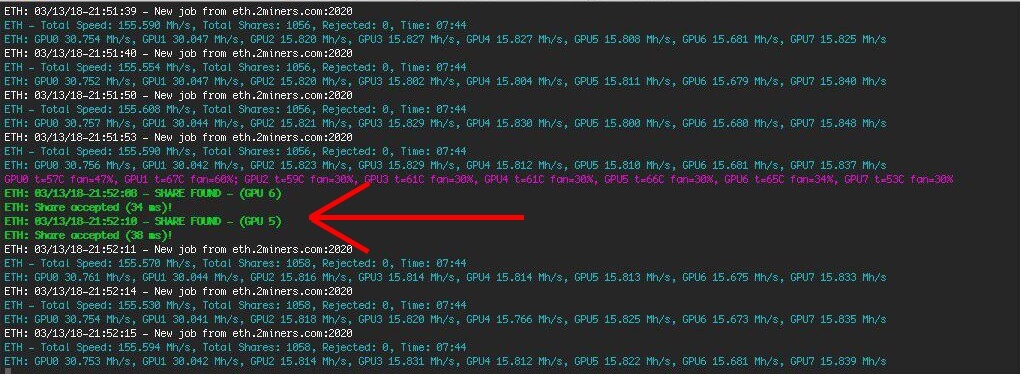
Mining pools need shares to estimate the miner’s contribution to the work performed by the pool to find a block.
Based on the shares that a miner sends to the pool, the pool then plots a miner hashrate graph. It also allows you to determine whether a miner is online or not, etc.
There are numerous miner reward systems: PPS, PROP, PPLNS, PPLNT, and many more. It would take too much time to describe all of them, so let’s focus on PPLNS for now.
How does PPLNS Work?
PPLNS stands for ‘Pay Per Last N Shares’, where ‘N’ is a random number determined by the mining pool operator. Suppose N equals 20,000. What does it mean?
It means that when the pool finds a block, your reward is calculated based on your contribution to the last 20,000 pool shares. So if Ether block reward is 2 ETH and you account for 1,000 of the last 20,000 pool shares, then you’ll get 5% of the reward – 0.1 ETH. On 2Miners you can automatically check your statistics and your current share rate on the pool.
For example, if you enter the following miner wallet address 0x244c12d0c1148f59d3f1684e562d3d5f9d1df8c6 in the upper right corner on the pool web page, you will get access to its statistics. In the top right corner you’ll find a miner’s share rate.
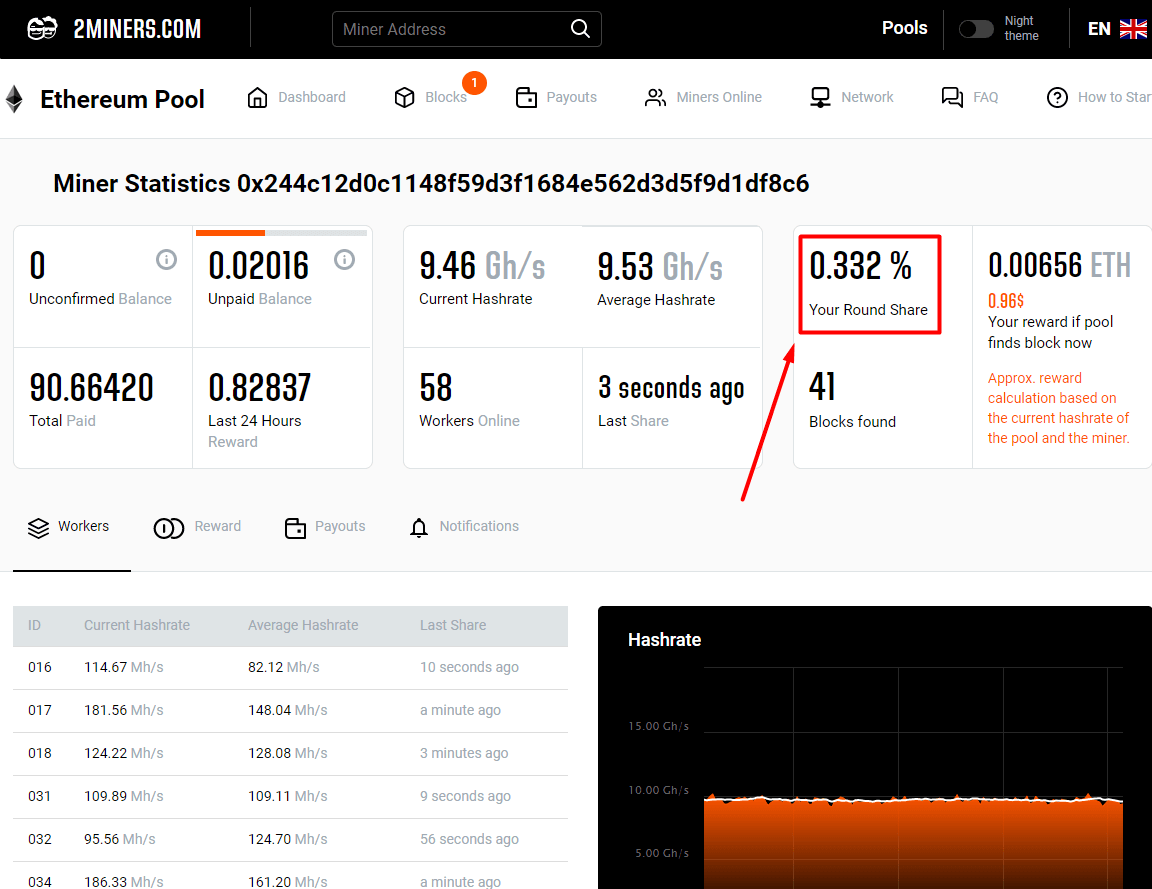
Share Difficulty
Let’s see what share difficulty means. In this case, we talk about 8.6G, although it may be 8G/16G/1000000G, etc.
Make sure to read our article about mining luck if you haven’t already. Now let’s take a look at Ethereum Network Difficulty:
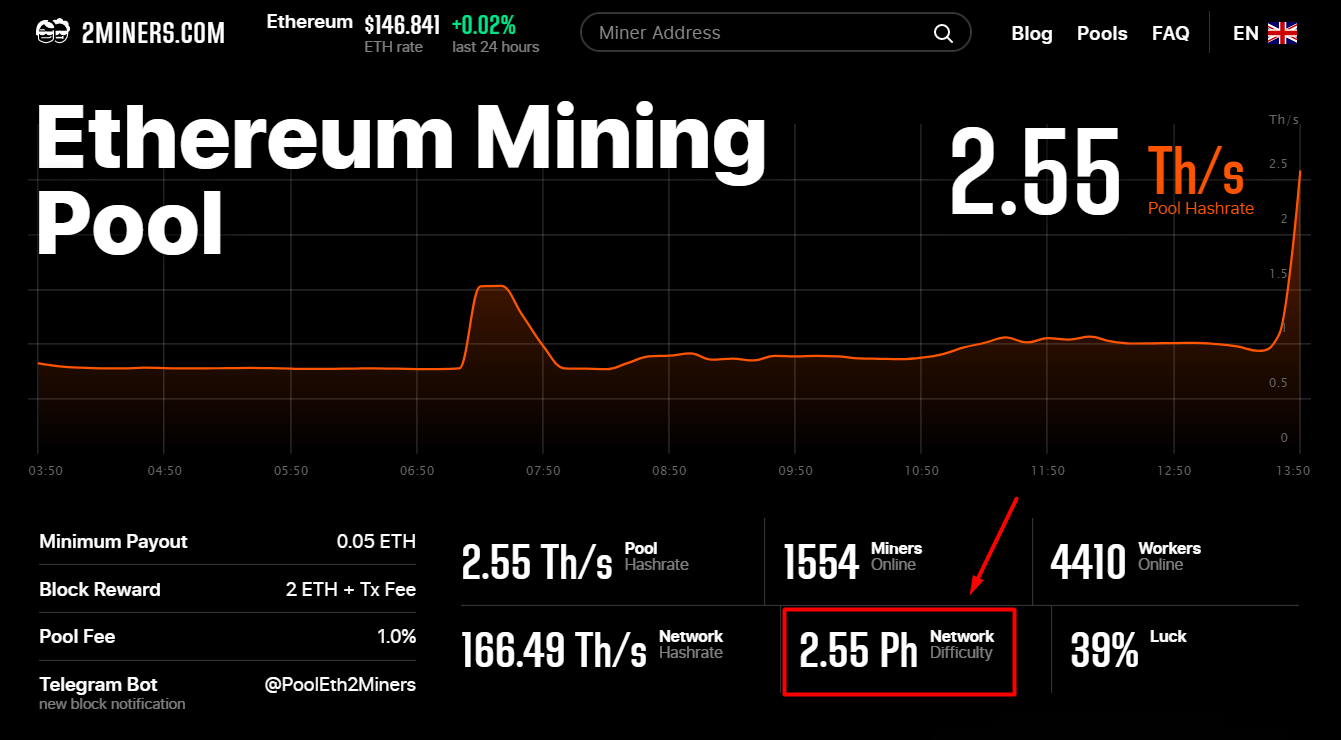
At the time when this article was written, Ethereum difficulty was 2.55 P = 2,550 T = 2,550,000 G. Sometimes it is measured in Ph/Th/Gh, but it’s all the same – Ethereum difficulty, in this case, is 2 Petahash = 2,000 Terahash = 2,000,000 Gigahash.
For the sake of simplicity, we will only consider the ideal world conditions, that is, 100% mining luck. Suppose pools line up to get blocks in ascending order of their hash rates: since 2Miners has 2 Th/s, it gets 10 blocks per day, while XMiners with its 10 Th/s gets 50 blocks per day.
In reality, it may go differently: today a specific pool with 2 Th/s might get 5 blocks, while tomorrow it might get 10 blocks, and the day after – 13 blocks, even though its hashrate is always 2 Th/s. But if you consider the more extended time factor, luck is still aimed at 100%, as mentioned in this article.
So, we have – an ideal world, 100% luck, Ethereum cryptocurrency network:
- If the share difficulty was 2.55 P, then every share would a be block solution.
- If the share difficulty was 1.28 P, then every 2nd share would be a block solution.
- If the share difficulty was 2.55 T, then every 1,000th share would be a block solution.
So if the Ethereum difficulty is 2.55 P and the pool share difficulty is 8.6 G, then in an ideal world a pool needs to receive 296,511 shares to find a solution for one block.
In reality, it may need only 10 shares or 2 million. If we consider the span of several weeks or even months with constant network difficulty and share difficulty, then the average number of pool shares per block will aim at 296,511 (of course if Network Difficulty and Pool Hashrate remain unchanged).
Share Difficulty and Mining Difficulty
- Share and block solution are different things.
- Share difficulty doesn’t affect the number of blocks found by a pool.
- Share difficulty doesn’t affect miner rewards.
- Shares are used by miners to monitor their rigs and by pools to distribute rewards amongst their miners.
If there is only one miner on the pool, then you can set share difficulty equal to network difficulty. In this case, pool stats don’t demonstrate anything at all, and then, all of a sudden, a block is found, after which days and days of waiting will follow again.
This scenario is very uncomfortable. And if there are several miners, then considering the elevated level of difficulty, the rewards distribution process becomes way too confusing.
Because of that even on the 2Miners Solo pools, miners send shares of lower difficulty. This is used mostly to monitor the rig activity.
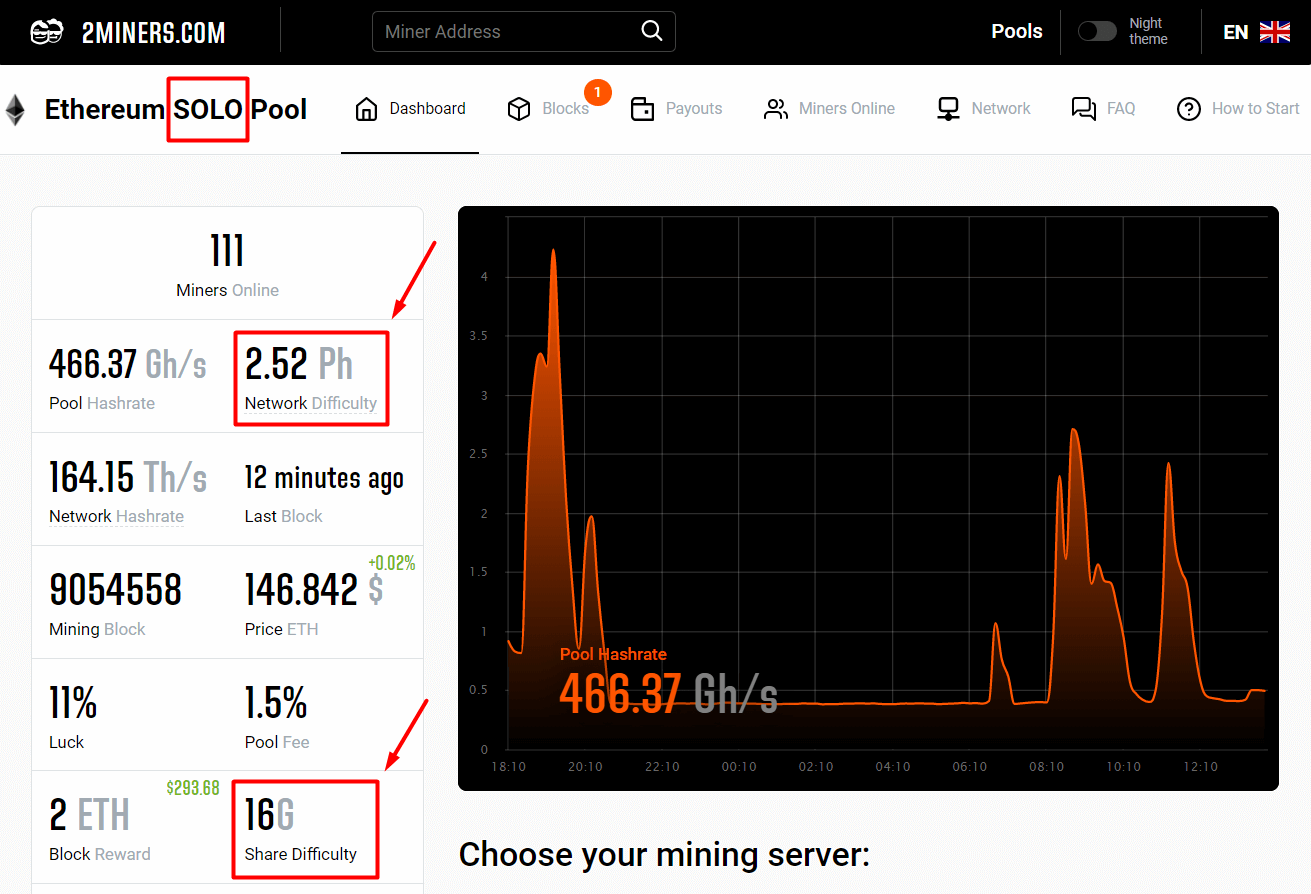
Pool share difficulty is chosen in a way that miners could work comfortably and see their detailed statistics, and pools could operate adequately without getting overwhelmed with the crazy number of shares they receive. The most important thing to remember is that the share difficulty doesn’t affect your mining reward anyhow.

The 2Miners pool co-founder, businessman, miner. In 2017 started mining cryptocurrencies and built many rigs on his own. As a result, he gained lots of practical knowledge and became interested in sharing it with others. In his articles on 2Miners, he shares useful tips that he tried and tested himself. For example, Darek gives advice on how to buy hardware components for the basic mining rig and how to connect them to each other correctly. He also explained lots of complicated terms in simple words, such as shares, mining luck, block types, and cryptocurrency wallets. After the pool was launched, he published a series of articles ‘Crypto Mythbusters’ where he explained how to protect the network against 51% attack, talked about cryptocurrency mining difficulty and difficulties of launching your own node.
What does Shares/Diff number represent on pools found blocks
When the pool I am mining finds a block what does the «Shares/Diff» number represent?
2 Answers 2
This is a proxy for «did we get lucky or not».
The shares numerator is the total number of weighted shares sent by miners trying to find the block. When you mine, you’re asked to solve an easier problem on that block template (and if you solve it with a large enough gap, you find the block). When you find one of those «subblocks», you submit it to the pool, which accumulates the difficulties of the submitted shares. When a block is eventually found, that accumulated number is roughly proportional to the number of hashes the pool’s miners have expended trying to find the block. So the shares numerator is a proxy for the total work done by the pool’s miners.
The Diff denominator is the block’s difficulty, which is proportional to the estimated number of hashes needed to find the block.
So the fraction represents how easily this block was found. If less than 1, you were lucky (it took less shares to find the block than expected). If more than 1, you were not (it took more shares to find the block than expected).
When the pool I am mining finds a block what does the «Shares/Diff» number represent?
I would need the source to be 100% sure but with the context provided I believe that is a measure of (work done by pool miners/blocks difficulty).
Work (hashes generated) by the pools miners is proportional to the number of weighted shares generated by miners while finding pools sub-blocks. Difficulty is based on the current estimated number of hashes that will be required to find a block on the Monero network.
In other words Shares/Diff is a measure of luck. Over (long periods of) time the fraction should approach 100%
If the fraction is below 1 then you are lucky. If the fraction is above 1 you are unlucky.
что таоке Shares/Diff на пуле
Сложность шар подбирается на майнинг-пуле таким образом, чтобы майнеры работали комфортно и видели подробную статистику своей работы, а пул не офигел от безумного количества полученных шар и не прилег отдохнуть.
ElliotFT
Друг форума
- 4 Июл 2018
- #11
Связь сложности шары и сложности майнинга
- Найденная шара и решение блока — разные термины.
- Сложность шар не влияет на количество блоков, найденных пулом.
- Сложность шар не влияет на вознаграждение, которое получает майнер.
- Шары нужны лишь для того, чтобы майнеры могли следить за работой ферм, а пул мог распределять награду между майнерами.
Сложность шар подбирается на майнинг-пуле таким образом, чтобы майнеры работали комфортно и видели подробную статистику своей работы, а пул не офигел от безумного количества полученных шар и не прилег отдохнуть.
Diff в майнинге что это
Reddit and its partners use cookies and similar technologies to provide you with a better experience.
By accepting all cookies, you agree to our use of cookies to deliver and maintain our services and site, improve the quality of Reddit, personalize Reddit content and advertising, and measure the effectiveness of advertising.
By rejecting non-essential cookies, Reddit may still use certain cookies to ensure the proper functionality of our platform.
For more information, please see our Cookie Notice and our Privacy Policy .