Pdo и pps что это
In the previous chapter, we talked about the control messages of the PD protocol layer. In this chapter, we mainly focus on data messages. I hope everyone can gain.
One, the basic structure of the data message

The figure above is the structure of the data message. It consists of a header+object (up to 7). The last chapter actually talked about this, and explained the header-related things. The VDM marked in red is also a data message, but this is a special data message called VDM, which is composed of the first message heder+VDMheader+object.
Data message header
The biggest difference between the header of the data message and the header of the control message is the number of objects. Those who have read the third chapter know that the bit14
12 field of the header indicates the number of items, then this 0 means the control message, this is not 0 Represents a data message. The other difference is in the bit4-0 field (message type) of the header. This field is separate. The control message has its own message type, so the data message also has its message type. The specific message types can be found in the PD3.0 standard document, which will not be repeated here. The following will introduce some common and important data message types.
Data message object

Master Hung made the structure diagram above. First, the data message includes PDO (power data object), RDO (request data object), and VDM (vendor define message). Data message types, of course, there are others, today this chapter will introduce these three items.
The first is PDO, PDO includes fixed (fixed voltage gear), pps (program power supply) programmable power supply, and there is a battery in the standard. Master Hung will not talk about it here, and interested students can check it out by themselves .
fixed power supply (5/9/12/15/20V)

The PDO of the fixed power supply type in the picture above was translated by the big brother himself. The difference in personal understanding may not be standard. The benevolent sees the benevolent, and the wise see the teacher Cang.
Two days ago, a classmate asked the big brother about the meaning of different data in each field. For example, what does it mean when the power type field is 2 in the figure above.
So Master Hung will give you some key points today.
1. Power source type field: here can only be 0, 0 means fixed power, 1 means battery, 2 means variable power, 3 means PPS
2. Peak current field: as the name implies, it means peak current, or overload capacity.
3. Voltage field: It is easy to understand here. It means voltage. If it is 60, then it is 100*50=5000 (mv), which means that this voltage is 5V.
4. The current field is the same as the voltage field.

The data format of the PPS power supply shown in the figure above. Half of them are reserved.
This is very easy to understand. First, the bit31
30 field is the power type field, which must be 11b, which is 3 in decimal.
The rest is literal, and the calculation method is the same as that of PDO voltage and current.
This is the PD’s PDO and PPS.
Today’s sharing is here. I hope you can help you. Those who find it helpful will pay attention, like, and comment. . . . Don’t prostitute for nothing.
QQ Seven One Seven Seven Two Zero Two One
QQ Seven One Seven Seven Two Zero Two One
Power Delivery Origin and Specification
In the past, electronic devices were mainly charged with interfaces provided by the manufacturer, which ended up in landfill when the product was replaced. The popularity of USB improved that picture, however capacity remained limited to a maximum of 7.5W (5V 1.5A) for USB Battery Charging 1.2 (BC1.2), and the devices themselves took a significant period of time to recharge.
The release of the USB-IF (USB Implementers Forum) USB Power Delivery Specification Version 1.0 in 2012 increased power supply capacity to a maximum of 100W (20V 5A). Following updates and the addition of more functions, the latest version is USB Power Delivery Specification Revision 3.0 (hereinafter referred to as PD or PD Spec).
Following current consumer trends, the Type-C interface has gradually become the mainstream choice, and most products now support PD. In these products, the Configuration Channel (CC) pin is used for transmitting PD communication messages and protocols and supplying power through the VBUS pin.
USB Type-C® Architecture (Source/Sink Detection)
From a power supply end and power consumption end perspective, the role of power can be broadly divided into three main types:
| Power Role | Definition |
| Source | For the power supply end with power supply capability, Rp is set on the CC pin |
| Sink | Rd is set on the CC pin of the power consumption end |
| DRP | To simultaneously enable Source and Sink, both Rp and Rd should be set on the CC pin |
Table 1. Power Roles
The docked ends are detected via CC and VBUS to see if a suitable device is connected to:
- Source: Monitors the CC pin voltage. When source detects Rd on the CC pin, it means Sink is connected and Source will output 5V on VBUS
- Sink: Detects VBUS. When the voltage is 5V, it means Source is connected
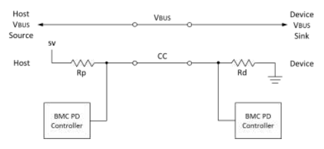
Figure 1: USB Type-C Connection Before PD communication (Source: USBType-C Cable and Connector Spec)
PD Architecture
Taking the Source end as an example, the Device Policy Manager is mainly responsible for monitoring the overall usage of the device. Its duties include managing the Power Source and USB-C® Port Control modules and cooperating with the Policy Engine to adjust the power distribution. Each port is connected to the device protocol according to the resources allocated. USB-C Control controls the Source/Sink Detection (described in the previous section). After that, PD behavior is jointly controlled by the Physical Layer (PHY Layer), Protocol and Policy Engine. Finally, the power is supplied to the other party through VBUS by Power Source.
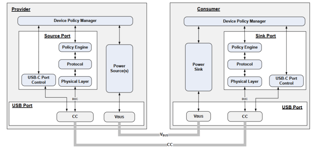
Figure 2. USB PD Structure (Source: PD3.0 spec)
- Policy Engine
The state of individual ports within the Device Policy Manager is provided, so that the Policy Manager can integrate and update the device state in real time and redeploy resources to each port. It determines how to send and respond to the received PD message according to the policy and instructs the Protocol Layer to construct the message.
- Protocol Layer
Sending message end: Receives the instruction from the Policy Engine, constructs the required message and sends it to the PHY Layer. It then confirms that the message has been sent correctly through GoodCRC and returned from the other party. Otherwise, it will be regarded as a transmission failure and the Retry mechanism will be triggered.
Receiving message end: Receives the message from the PHY layer, interprets the message and reports it to the Policy Engine. Before responding, this end will first construct a GoodCRC message and let the PHY send it back to the other party, indicating that the message has been correctly received and interpreted.
At the same time, the Protocol Layer of each device needs to calculate whether the other party replies with a corresponding response within the required time (Timer check).
If any error is detected in the above confirmation, Protocol Layer of either party can initiate the Reset mechanism to adjust the state:
| Reset Type | Purpose |
| Soft Reset | Protocol Layer reset (including timer, counters and states). Does not affect the agreed Power role, Data role and the agreed Voltage and Current before Reset. |
| Hard Reset | Will be used if Soft Reset cannot resolve the current error. Except for the Power role, all the PD protocols are restarted. In this process, the Source end will temporarily turn off the VBUS voltage to 0V, then turn it on until 5V and reconnect with the Sink protocol. |
| Cable Reset | Only the DFP on the Host end can initiate a Cable Reset to reset communication with the cables. |
| Data Reset | Reset the USB data device. After a reset, devices at both ends will not be in Alternate Mode. |
Table 2. Reset Types
- PHY Layer
PHY reprocesses the message sent from the Protocol layer and composes a complete message together with SOP*, CRC, EOP and Preamble encoded in 4b5b mode. Then it is sent to the other party in BMC mode through CC.
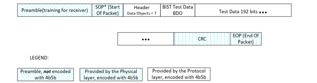
Figure 3: PD Message Format (Source: PD3.0 spec)
When it receives a message, PHY will first verify it by conducting a CRC (cyclic redundancy check). If the message is correct, it is sent on to the Protocol Layer at the receiving end.
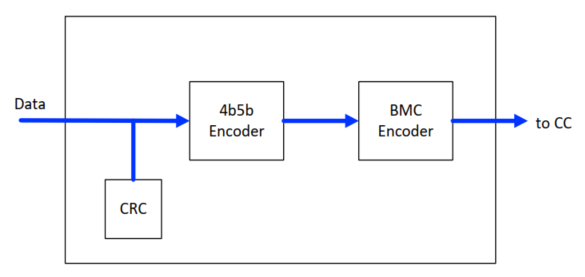
Figure 4: PHY Layer Message Transmission Flow (Source: PD3.0 Spec)
Taking the Source Capabilities message as an example, Figure 5 (below) briefly shows the sending end, receiving end and message transmission flow of the above content:
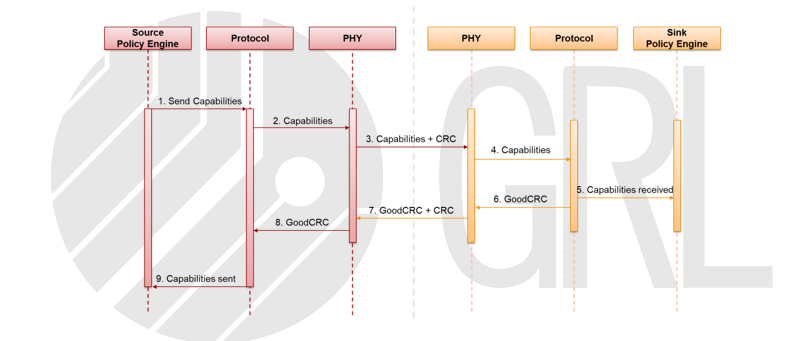
Figure 5: Source Capabilities Messages
Figure 5 shows that the PD messages of the devices at docking ends are transmitted by the same route (CC). To avoid sending messages at both ends at the same time, Source Protocol has a Collision Avoidance mechanism which tells Sink whether it can respond only to Source messages by instructing PHY to control Rp settings.
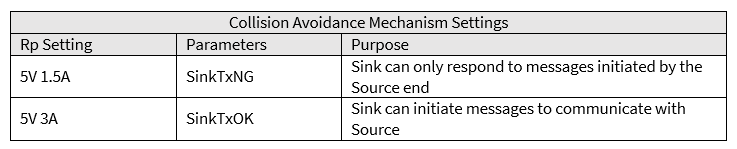
Table 3: Collision Avoidance Setting
PD Protocol
1. SOP* Communication
Before learning how to communicate, it is important to understand that the objects of PD message transmission can be divided into three types – SOP, SOP’ and SOP».
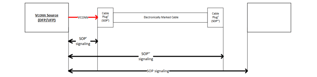
Figure 6: SOP/SOP’/SOP» Communication Diagram (Source: PD3.0 Spec)
SOP is used for messages between Source and Sink. SOP’ is used for messages close to Vconn Source (for supplying power to e-Markers in cables), and SOP» is used for messages delivered to the cable’s far-end e-Marker.
* Not every cable is equipped with an e-Marker. However, according to the PD Spec rules, if any cable supports SuperSpeed or a current greater than 3A, there must be an e-Marker.
2. Implicit PD Contract
The Source/Sink power supply protocol is subject to intermediate cable conditions. For example, if the Source current supply is up to 5A, and the cable used can only support a maximum current of 3A, then the Source cannot create a protocol with Sink. Usually, Source will first send a Discover ID Request in the form of SOP’ and read the cable information through the Discover ID ACK returned by the e-Marker.
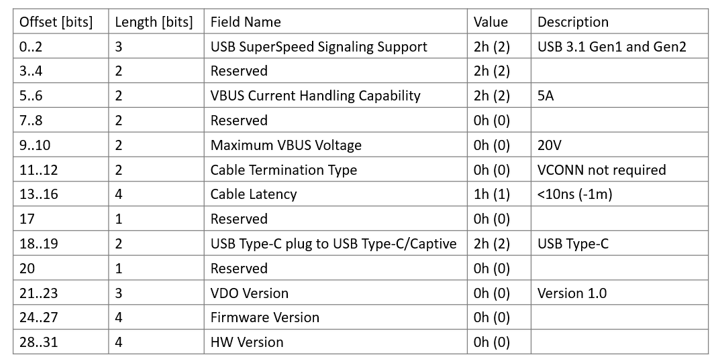 Figure 7: Analyzing the Discover ID ACK by GRL-A1
Source will send Source Capabilities to Sink to indicate the power supply capacity at the current state, referring to the conditions that the cable can support. Sink will select from the conditions and return a Request to Source for the required voltage and current. After receiving confirmation for supplying power at this condition, Source will reply Accept, and send PS RDY once it is prepared. At this step, the Implicit PD Contract is complete. After that, the two parties can renegotiate a new PD contract depending on the situation.
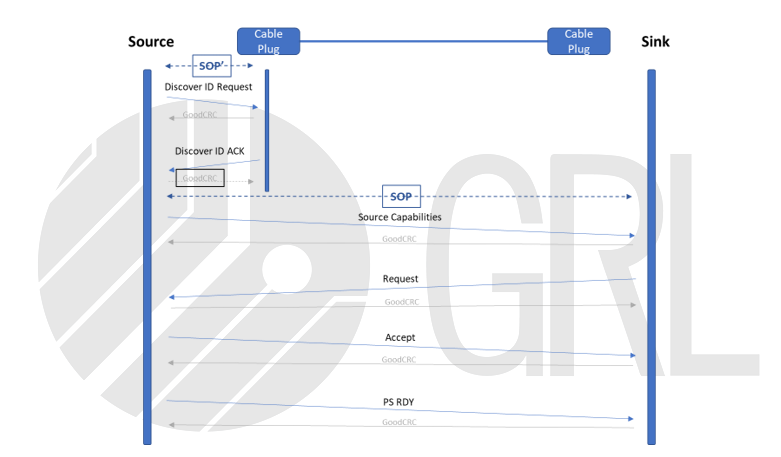
Figure 8: Implicit PD Contract Flow
Source Capabilities
The PD Spec also contains relevant chapters to explain the rules for the Source Capabilities specifications. The following are drawn from the PD 1.0 to PD3.0 specifications.
USB PD 1.0
There is no mandatory specification for the power supply end. Several recommended settings are listed, referring to the charging requirements of most products.
*To comply with international safety standards, the power supply capacity is limited to 100W, and the current is limited to 5A.
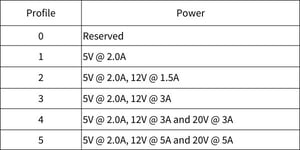
Table 4: PD 1.0 Recommended Power Supply Specifications (Source: PD1.0 Spec)
USB PD 2.0
Following the introduction of USB PD 2.0, the specification requires the power supply end in products to meet certain conditions (see Table 5 below). For example, if the maximum power is 36W, then it is necessary to set a combined power supply capacity of 5V 3A, 9V 3A and 15V 2.4A. This condition will be listed in the PDO (Power Data Object) field in Source Capabilities. Each product can add other combinations according to demand, except for the ones in the table, which are limited to 7 groups.

Table 5: PD2.0 Power Supply Specifications (Source: PD2.0 Spec)
* Since August 2020, USB-IF has terminated all certifications that only support products featuring PD2.0 or below.
USB PD 3.0
The power supply specification for USB PD 3.0 is as follows (see table 6), and an optional PPS (Programmable Power Supply) function is added. In PPS mode, the voltage can be adjusted by 20 mV/step, and the voltage range is extended to 3.3 V to 21 V. This technology can output large currents at lower voltages and greatly improves charging efficiency.
To distinguish the new PPS mode in PD3.0 from the existing PD2.0 mode, PDO can be divided into according to the following rules:
- Fixed Supply PDO (usually called Fixed PDO) refers to fixed voltage output mode.
- Augmented PDO (usually called APDO) means that the output voltage can adjust within a certain range under PPS mode.
Similarly, taking 36W as an example, if a product is required to support PPS (optional), it must include:
- Fixed PDO:5V@3A、9V@3A、15V@2.4A
- APDO:3V
11V (9V Prog)@3A、3.3
Since the 5V Prog is covered by the 9V Prog specification, if the two APDO settings are the same, the 5V Prog can be skipped and only 9V Prog needs to be listed.
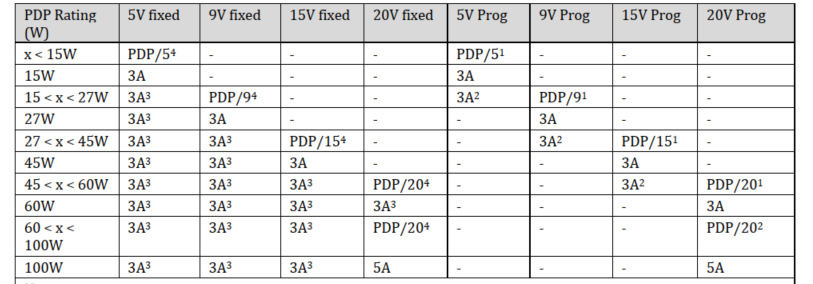
Table 6: PD3.0 Power Supply Specifications (Source: PD3.0 Spec)
References
- USB Type-C® Cable and Connector Specification Revision 2.0
- USB Power Delivery Specification Revision 1.0 Version 1.2
- USB Power Delivery Specification Revision 2.0 Version 1.3
- USB Power Delivery Specification Revision 3.0 Version 2.0
Author
Cindy Chang – Test Engineer, GRL (Taipei)
A graduate of the Department of Materials at National Cheng Kung University, Cindy Chang has more than three years of Power Delivery-related testing experience and is familiar with a variety of test specifications, such as Thunderbolt PD, USB-IF PD Compliance, and Qualcomm Quick Charge (QC). As a Test Engineer with GRL Taipei, she is responsible for helping customers to solve PD problems and obtaining certification.

What is PPS Fast Charging, and What’s the Difference Between PD, QC, and PPS?

Mobile devices are becoming more powerful by the day and their power consumption has increased drastically, making fast charging indispensable. In 2017, the USB Implementers Forum (USB-IF), the organization that supports the advancement of USB technology, added PPS fast charging to the USB PD 3.0 standard, creating a unified solution for today’s fast charging devices. That same year, Qualcomm’s QC 4.0 met the PPS standards, attaining a unified charging scheme.
So, what is Programmable Power Supply (PPS)?
PPS fast charging is the most advanced charging technology for USB-C devices. The technology adjusts the voltage and current in real-time, depending on a device’s charging status, feeding it with maximum power.
What’s the Difference Between PPS, PD, and QC?
Programmable Power Supply PPS allows for stepwise changes in current and voltage. It decreases the conversion loss during charging, ensuring the charge is more efficient. When the charge is more efficient, less heat is produced, and when less heat is produced, a battery’s lifespan increases. So, PPS fast charging is better for your device’s battery.
Power Delivery (PD) is a standard for handling higher power that was introduced by the USB Implementers Forum. It allows devices to charge fast over a USB connection. It provides high-speed charging with variable voltage using intelligent device negotiation. Devices negotiate a power contract to determine how much power they can pull from a PD charger.
Power Delivery is designed to allow devices to fast-charge over a USB connection. Its newest version, PD 3.0, is one of the most popular fast charging protocols. PPS is the latest addition to the PD 3.0 standard. PPS and PD protocols work seamlessly together. PPS allows for renegotiation of non-standard currents and voltages between the charger and the device.
Quick Charge (QC) is one of the most common fast charging protocols on the market and is found in many popular smartphones. It was invented by Qualcomm, which makes mobile CPUs. The charging standard supports backward compatibility, which means a QC 4+ charger can fast-charge a QC 3.0 device. Quick Charge achieves fast charging by increasing the charging voltage, boosting the wattage in the process. QC 5, the latest standard in Quick Charge technology, can recharge smartphones to 50% in five minutes.
Which Devices Support PPS?
Samsung Galaxy S20 was the first phone certified for PPS fast charging, but there are three other devices that likewise support the standard: Samsung note10, Samsung S20 ultra, and Samsung S21.
Can PPS Charge Laptops?
Yes, many laptops support the PPS charging protocol and can be charged faster, safely, and more efficiently.
Get One of These Two RAVPower PPS Fast Chargers
1. PD Pioneer 20W Wall Adapter (RP-PC150)

When it comes to tech, the general consensus is that smaller is better. This RAVPower charger with PPS fast charging is small in stature but big in performance. It was specifically designed for the iPhone 12 series and offers a total output of 20W.
The charger is the same size as Apple’s 5W charger but delivers up to 3 times faster charging speeds. It supports PPS, USB PD 3.0, and QC 3.0 for wider compatibility. The wall charger optimizes charging speeds for almost all USB-C powered mobile devices. If your bag is already spilling over with accessories and you’re looking for a tiny, powerful charger, get it. RAVPower sells two in a set.
2. PD Pioneer 30W 2-Port Wall Charger (RP-PC144)

iPhone 12 owners need a new power brick to make use of the phone’s maximum 20W wired charging rate. Apple recently announced that it will no longer be including power adapters with the iPhone, so it’s important to get a charger that is specifically designed to replace the Apple adapter, like the RP-PC144.
The RAVPower PPS fast charger is designed for the iPhone 12 series and is MFi certified. Also, it has a total power output of 30W and 2 ports: a 20W USB-C port and 10W USB-A port. The USB-C port features PD 3.0 fast charging and can charge an iPhone 12 from 0% to 50% in about 30 minutes. The power adapter comes with an MFi-certified USB-C to Lightning cable.
3 RAVPower Chargers Which Support PD and QC Charging Standards
1. PD Pioneer 61W GaN Wall Charger (RP-PC112)

The RP-PC112 uses both USB-C and gallium nitride (GaN). GaN allows charger chips to be smaller, creating a power brick that’s small enough to fit in a trouser pocket. Therefore, these two technologies make the wall charger both small and affordable. What’s more, foldable prongs ensure it is fully portable.
The power adapter also has safety features and protects your devices as it juices them. They are safe from overvoltage, short-circuiting, and overheating. In addition, it pushes 61W of power and can charge iPhones two hours faster than other chargers. But you need a USB-C to USB-C cable to activate the QC technology.
2. PD Pioneer 20000mAh 60W 2-Port Power Bank (RP-PB201)

When looking for a power bank that can charge your laptop or gaming console, there are two important things to consider: can it deliver enough power to your device and can it do so fast? Laptops and consoles can’t charge over a standard USB port; they need a PD port.
The RP-PB201 has one PD port and one QC port to fast-charge your laptop and phone simultaneously. It can charge your MacBook Pro just as fast as its original charger. It has a smaller, less bulky design and is shorter and narrower than most smartphones.
3. Portable 252.7Wh Power House with AC Outlets (RP-PB187)

Sometimes you need a big power boost, not just a little, especially when there’s a power outage, and that’s where the RAVPower Power House comes in. If you want a charger that can power a laptop, tablet, smartphone and a console, this is it. You won’t have any problems charging your devices to full capacity multiple times. And we’re talking about mainstream devices here, like the MacBook Pro, the Samsung Galaxy S20 Ultra, and the iPhone 12 Pro Max.
The portable power station has a 60W USB-C PD port and two AC Outlets. These can power handheld devices as well as small appliances, like a drone and a car refrigerator. The power bank has a very small footprint and is lightweight for a portable power station. RAVPower provides a carrying bag, an AC adapter for recharging it, and a USB-C to USB-C cable.
Visit our website for more!
Related
7 Replies to “ What is PPS Fast Charging, and What’s the Difference Between PD, QC, and PPS? ”
“consensus on tech is that smaller is better”
I respectfully disagree. IMHO excessive miniaturization is also a bad thing. I am an early phablet adopter (before the term existed) and my favorite for size is still the Nexus 6 (no suffix). I realize I’m in the minority on that, but for me the perfect phablet is the largest device that still fits in my pocket(s): anything larger is a de-facto tablet. In particular I’m not happy with the ever longer & narrower candy bars.
Foldables are interesting and I used to own flips but until the former’s reliability track record & the latter’s software & firmware components improve, I’m sticking with the largest standard device with the most frequency bands & 5G I can get–in my particular case it is likely I’ll upgrade from a Pixel 3XL to a Pixel 6 Pro because of various Samsung problems and because the Pine Phone is still early-to-mid beta.
What if a charger supports PD but not with PPS? Will it charge fast with no issues?
Hi Wael, PPS is a supplementary protocol for PD. Not all devices support PPS. Therefore, many chargers do not support PPS (not required), but can charge devices that support PD protocol.
Also, there are devices which support PPS, and not PD.
Hi, could you please contact our customer service team who will be able to help, reach them at support@ravpower.com
can I use charger PD or PD+PPS to enable quick/fast-charging (9/12v) phone based QC3/4/5 (like Xperia Z5 mini/OnePlus 5T)? thankyou
Ликбез по Power Delivery: что стыдно не знать о стандарте быстрой зарядки
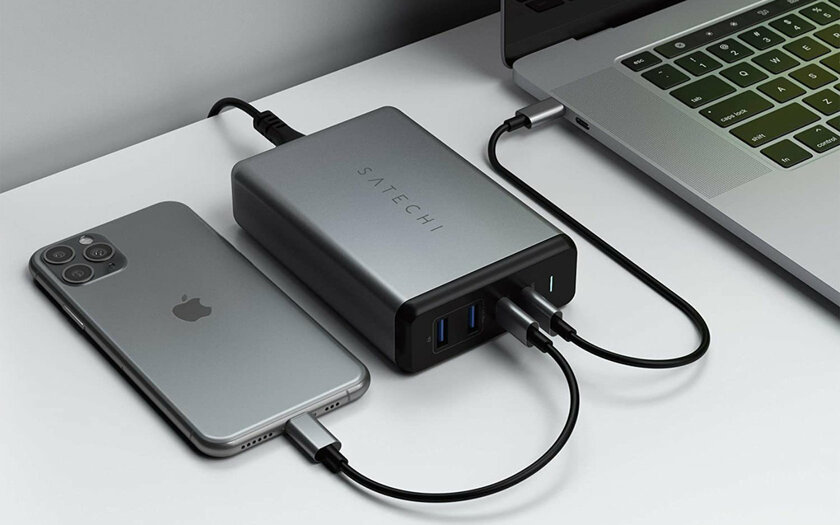
Когда энергия в аккумуляторе мобильного устройства стремительно заканчивается, быстрая зарядка становится настоящим подарком. Впрочем, разнообразие как проприетарных, так и лицензированных стандартов затрудняет определение того, какую именно скорость выйдет получить при использовании конкретных блока питания и кабеля. Конечно, можно ориентироваться только на комплектные аксессуары от производителя гаджета, но обойтись одной зарядкой сегодня — не самая простая задача. Выходом становится Power Delivery — актуальная официальная спецификация быстрой зарядки USB Promoters Group.
- В тему:Что такое GaN-зарядки и чем они отличаются от обычных адаптеров
Power Delivery (PD) — универсальная спецификация, разработанная как общий стандарт быстрой зарядки, который можно использовать с любыми гаджетами с поддержкой USB-интерфейса. PD существует с 2012 года — примерно с того же момента, когда представили порт USB-C. Новый стандарт зарядки стал заменой для спецификации USB Battery Charging (USB BC), которая дополняла базовые параметры питания USB-порта. На данный момент пользователям и производителям доступна уже третья редакция Power Delivery, которая заточена для эффективной быстрой зарядки.
Что нужно знать про зарядку гаджетов через порты USB
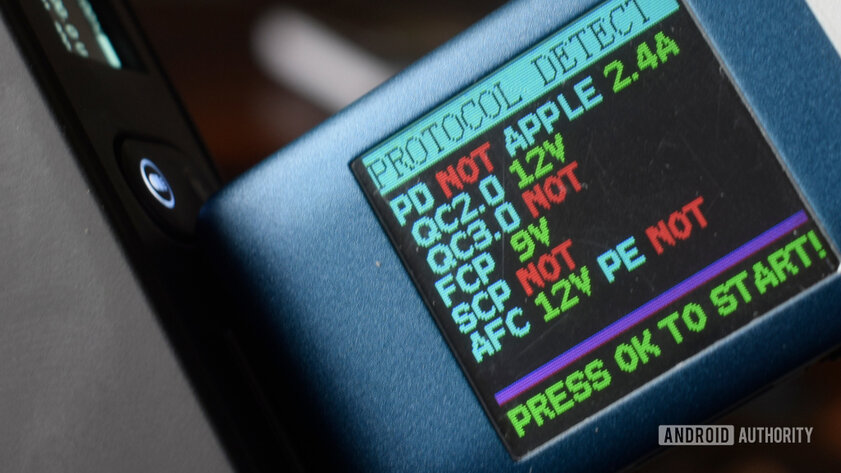
Современные порты USB-С поддерживают несколько стандартных спецификаций зарядки. Более того, производители могут комплектовать их дополнительными проприетарными возможностями.
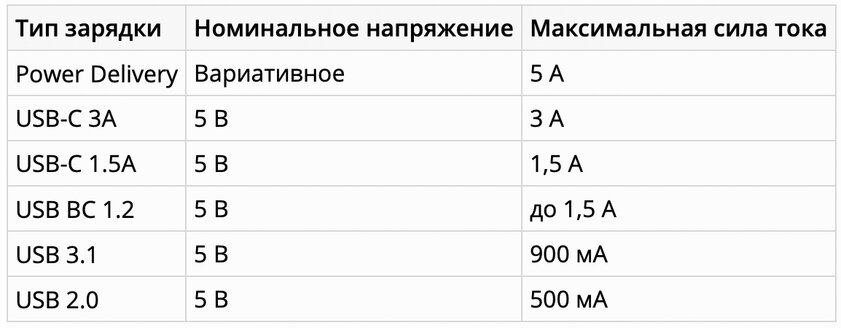
Для начала важно отметить, что абсолютно все USB-порты поддерживают базовый уровень зарядки от 5 В и 500 мА до 5 В и 900 мА. Да, скорость наполнения энергией в данном случае будет крайне медленной, но это нужно для работы с устаревшими девайсами, а также маломощными гаджетами. Порты USB-С базово можно «разогнать» до 5 В и 1,5 А и даже 15 В и 3 А. Это намного быстрее, но всё ещё достаточно медленно, если говорить про стандарты быстрой зарядки в целом.
Стандарт Power Delivery отличается куда большей скоростью — он может работать даже с мощностью 100 Вт, чего уже будет более чем достаточно и для самых требовательных гаджетов вроде ноутбуков. Важным нюансом работы с PD является безопасность — когда гаджеты используют данный стандарт, они согласовывают необходимую мощность через USB-кабель. Спецификация поддерживает варианты зарядки с напряжением 5 В, 9 В, 15 В и 20 В, чтобы обеспечить мощность от 0,5 до 100 Вт. Новый стандарт программируемого источника питания USB Power Supply (USB PD PPS) также поддерживает определение напряжения, что нужно для более оптимальной зарядки. Если блок питания и гаджет не могут согласовать необходимую скорость зарядки, используется базовая.
💡 Мощность равна произведению напряжения и силы тока.
Сегодня Power Delivery используется для быстрой зарядки смартфонов, ноутбуков и других гаджетов. Google взял стандарт на вооружение для линейки Pixel, Samsung использует его для серии Galaxy S, а Apple — в iPhone и MacBook. Внушительное число других производителей добавляют работу с PD к своим проприетарным технологиям быстрой зарядки.
На данный момент есть три поколения стандарта Power Delivery
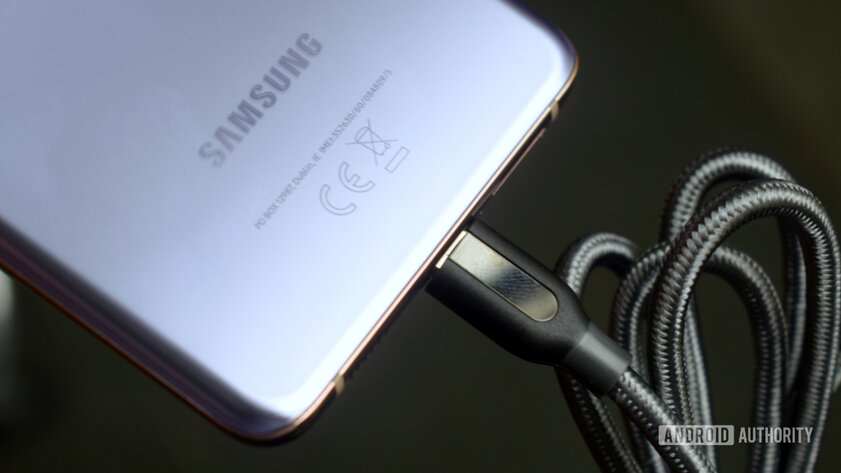
На данный момент стандарт Power Delivery находится уже в третьей редакции, которая характеризуется индивидуальным набором особенностей и возможностей. Впрочем, PD отличается обратной совместимостью, поэтому особенно переживать по поводу выбора не стоит.
Первая редакция Power Delivery была заметно более простой, чем современные. Она предлагала шесть фиксированных профилей питания для разных категорий гаджетов: 10 Вт (5 В, 2 А), 18 Вт (12 В, 1,5 А), 36 Вт (12 В, 3 А), 60 Вт (12 В, 5 А), 60 Вт (20 В, 3 А) и 100 Вт (20 В, 5 А). Такое разнообразие по мощности уже можно считать достаточным, но сегодня для огромного зоопарка из девайсов разных форматов требуется ещё большая гибкость.
Во второй и третьей редакциях Power Delivery от набора фиксированных профилей было решено отказаться. Конкретные значения по напряжению в них остаются, но сила тока может меняться в согласованном диапазоне. В итоге получается ещё более универсальный подход к зарядке абсолютно любых гаджетов. От второй третья редакция PD отличается контролем состояния аккумулятора, повышенной безопасностью и возможностью изменения напряжения по мере зарядки.
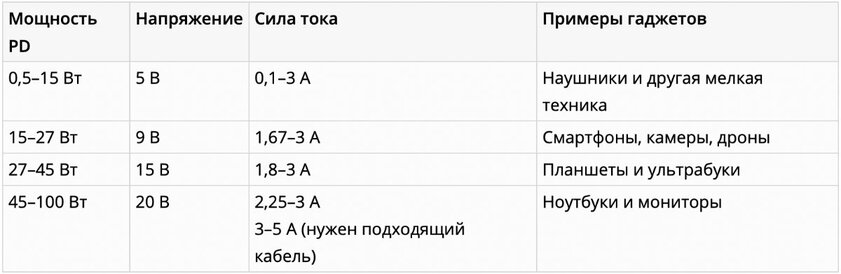
Подавляющее большинство современных устройств использует вторую и третью редакцию Power Delivery. Для смартфонов типичная мощность зарядки — 18 Вт, для ноутбуков — около 60 Вт. Впрочем, некоторые мобильные устройства всё же настроены на работу с большей скоростью — к примеру, VOOC Flash Charge уже поддерживает мощность свыше 100 Вт.
Как работает программируемый источник питания USB PD PPS
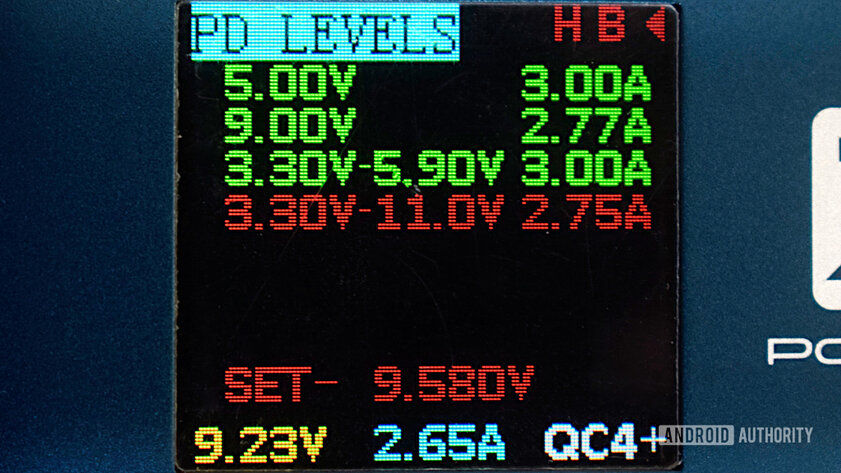
Вторая и третья редакции Power Delivery весьма технологичны, но всё ещё не в полной мере соответствуют требованиям гибкости для действительно быстрой зарядки. Её скорость крайне чувствительна к определённому напряжению, которое должно меняться по мере наполнения аккумулятора энергией. Варианты напряжения 5 В, 9 В, 15 В и 20 В из стандартной спецификации PD далеки от идеала для оптимальной быстрой зарядки.
Одной из особенностей третьей редакции Power Delivery, которую представили в 2018 году, стал программируемый источник питания USB PD PPS. Он отличается заметно большей гибкостью и предлагает шаг напряжения на уровне 20 мВ (0,02 В). Более того, в данном случае необходимое напряжение может быть не только согласовано, но и изменено прямо во время зарядки. Для быстрого наполнения устройства энергией это очень важно.
В первой половине 2021 года USB PD PPS — всё ещё диковинка. Его поддержка реализована всего в нескольких гаджетах и аксессуарах, и это создаёт трудности для потребителей. К примеру, для быстрой зарядки Samsung Galaxy S21 нужен блок питания именно с поддержкой USB PD PPS — только с ним смартфон сможет принимать 25 Вт. При использовании же традиционного стандарта Power Delivery гаджет сможет получить только 18 Вт.
Как быстро гаджеты заряжаются с помощью Power Delivery
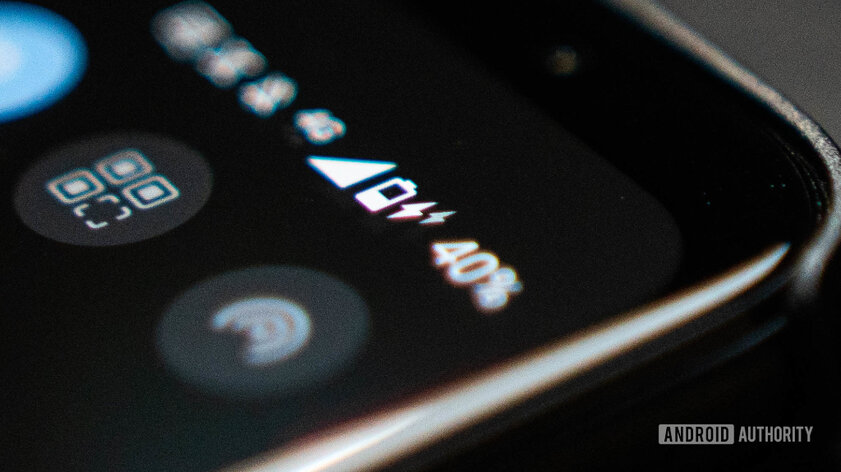
Стандарт Power Delivery характеризуется внушительным спектром вариантов итоговой мощности. Более того, его поддерживает масса устройств, которые отличаются, в том числе, и по ёмкости аккумулятора. Поэтому дать чёткий ответ на вопрос подзаголовка достаточно сложно. Впрочем, обычно смартфоны используют мощность 18 Вт и полностью заряжаются примерно за час с лишним. Ноутбуки же с блоками питания на 60 Вт могут получить необходимый объём энергии приблизительно за час или два.
В отличие от ноутбуков, смартфоны, как правило, предпочитают более низкое напряжение (5 или 9 В) и высокую силу тока. К примеру, технология OnePlus даёт возможность разогнаться до 65 Вт при 10 В и 6,5 А, а 40 Вт от Huawei базируются на 10 В и 4 А. Это — проприетарные варианты. Тем не менее они показательны.
Ближайший вариант напряжения в PD — 9 В. При его использовании в рамках стандарта скорость зарядки теоретически может составлять 27 Вт. Но для работы со смартфонами Power Delivery обычно использует более низкую силу тока, которая не дотягивает до 3 А. Поэтому на выходе получается 18–20 Вт — это заметно меньше, чем у протоколов быстрой зарядки, разработанных отдельными производителями гаджетов.
Впрочем, у PD всё же есть перспективы в мире универсальных стандартов быстрой зарядки. При использовании PPS Samsung Galaxy S21 может заряжаться на скорости 25 Вт при напряжении 9,5 В. А в Galaxy Note 10 Plus компании удалось добиться быстрой зарядки с мощностью 45 Вт. Тем не менее нужно понимать, что реализацию настолько большой мощности в Samsung сочли слишком сложной с точки зрения работы аккумуляторов, поэтому кроме перспектив у Power Delivery также хватает и вопросов.
Power Delivery вряд ли будет конкурировать с проприетарными стандартами быстрой зарядки. В своих смартфонах OPPO тизерит поддержку 100 Вт, а Xiaomi уже реализовала 120 Вт. Без существенной переработки у PD нет шансов даже вместе с PPS. Впрочем, если объективно, сегодня даже 40 Вт уже более чем достаточно для действительно быстрой зарядки того же смартфона.
Кроме удобства Power Delivery играет на пользу и экологии
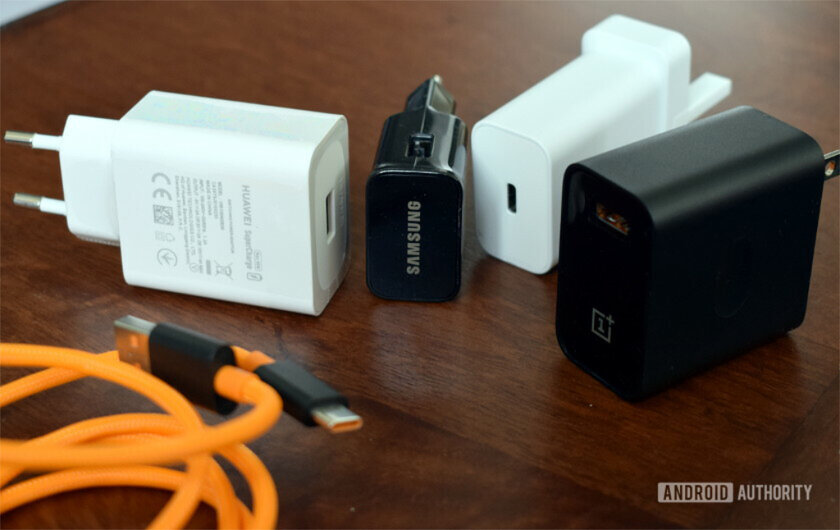
Конечно, высокая скорость зарядки является важной особенностью Power Delivery в целом и PPS в частности. Тем не менее куда важнее универсальность. PD был создан как единый стандарт для питания по USB широкого спектра гаджетов. Он нивелирует необходимость в проприетарных портах и особенных блоках питания.
Прежде всего, это крайне положительно сказывается на простоте подключения и зарядки. Но есть и вторая сторона медали — отсутствие необходимости оснащать каждое новое мобильное устройство отдельным блоком питания. Обилие старых кабелей и других аксессуаров для зарядки, которые остаются на свалках и не так просты в переработке, становится всё большей проблемой. Она также усугубляется ограниченностью драгоценных металлов и других элементов, которые используются на производстве. Power Delivery — это серьёзный ответ на сложный экологический вопрос.
Конечно, производители, которые убирают блоки питания из коробок своих устройств сегодня, пока не особенно радуют пользователей. Последние могут не обладать подходящими аксессуарами, поэтому должны приобретать их отдельно. Но в долгосрочной перспективе ситуация придёт в норму. Каждый из нас не будет заморачиваться, чем именно заряжать свои гаджеты, — по крайней мере, если Power Delivery станет единым решением, которое возьмут на вооружение абсолютно все.