Use of OAI-PMH
OpenAIRE uses the OAI-PMH v2.0 protocol for harvesting publication metadata.
Metadata Format
OpenAIRE expects metadata to be encoded in the Dublin Core metadata format (metadataPrefix oai_dc ). For information on how to use the individual DC fields, please refer to the section “Use of OAI-DC” below.
OpenAIRE OAI Set
For harvesting the records relevant to OpenAIRE, the use of a specific OAI-Set at the local repository is mandatory. The set must have the following characteristics:
| setName | setSpec |
|---|---|
| OpenAIRE | openaire |
A harvester only uses the setSpec value to perform selective harvesting. The letters of the setSpec must be in small caps.
Set content
Publications to be inserted in the OpenAIRE set must conform to at least one of the following criteria:
- They are available in Open Access (full text with no access restrictions)
- They are the outcome of a funded research project identified by a project identifier (see below) regardless of their access status (see section below on [[Literature Guidelines: Metadata Field Access Level|Application Profile Field Access Level]]).
Compatibility of aggregators
Besides individual repositories and journals, also aggregators (e.g., on the national level) can become OpenAIRE compatible. In this case, additional provenance information on the original content providers harvested by the aggregator has to be encoded for OpenAIRE. In accordance with the OAI-PMH guidelines, the provenance information has to be provided in the about element of an OAI record, as displayed in the following example:
© Copyright 2015, OpenAIRE. This work is licensed under Creative Commons Attribution 4.0 International. Revision a38ebd58 .
Frequently Asked Questions
This is where you will find most answers. If there should still be any questions left, don’t hesitate to contact us .
About OpenAIRE
- find all the publications and data of your project
- disseminate your research outputs
- comply with EC and national funders’ Open Access policies for publications and data
- collect all of your projects’ outputs in one place
- comply with EC and national funders’ Open Access policies for publications and data
- streamline the interoperability between your repository and the EC’s reporting tool for publications
- increase your visibility
- keep track of all research output funded by your funding stream
- keep track of the availability in Open Access research output stemming from your funding stream
- gain greater insight into your funding impact through tailor made statistics
It launched in 2013, allowing researchers in any subject area to upload files up to 50 GB.
OpenAIRE is a European project supporting Open Science. On the one hand OpenAIRE is an network of dedicated Open Science experts promoting and providing training on Open Science.
On the other hand OpenAIRE is a technical infrastructure harvesting research output from connected data providers. OpenAIRE aims to establish an open and sustainable scholarly communication infrastructure responsible for the overall management, analysis, manipulation, provision, monitoring and cross-linking of all research outcomes.
This combination of knowledge and a pan-European Research Information platform enables us to provide services to researchers, research support organisations, funders and content providers such as:
- Integrated scientific information: links publication, project information, datasets. per funder/project/content provider. and presents them in an in one place
- Monitor and reporting on OS research outcomes for funders
- Training sessions and support on all subjects related to OS and OS policy
- Discovery of OS output per project, funder, data provider…
- Exchange of metadata and content amongst data providers
- A general purpose repository called Zenodo
- An Open Science helpdesk
- Monitoring and reporting mechanisms for research output per institution
- Analyses massive collections of documents, related meta-data and relational information
General on Open Access
You can find an overview of trusted open access journals in the Directory of Open Access Journals.
A persistent identifier (PID) is a long-lasting reference to a resource. That resource might be a publication, dataset or person. Equally it could be a scientific sample, funding body, set of geographical coordinates, unpublished report or piece of software. Whatever it is, the primary purpose of the PID is to provide the information required to reliably identify, verify and locate it. A PID may be connected to a set of metadata describing an item rather than to the item itself.
There are different PID types for different kinds of resources. In the current research environment we most commonly see two varieties: those for objects (publications, data, software, such as URNs, DOIs, ARKs, Handle) and those for people (researchers, authors, contributors, such as ORCIDs, ISNIs). Many repositories will assign a PID of the former type when an object is deposited.
Open Access is not an infringement on copyright, in fact making your work open access is perfectly legal.
Authors (or their institutions) own the original copyright to their research, but when publishing the original rights holders are often asked to transfer these rights to the publisher, so that the publisher sets the terms for providing open access. OpenAIRE encourages researchers to choose publishers who let them retain their author rights, so that immediate access can be provided. Ideally, an open license is applied to the work, so that access and reuse rights are clearly defined for every end-user. Creative Commons (such as CC BY 4.0 for publications and CC0 for data) or GNU (for software and code) are very suitable for this purpose. If the publisher does not standardly allow you to retain your rights, please consider negotiating this using with an addendum to the publication agreement.
Some publishers of Open Access journals ask for a transfer of copyrights but still provide immediate open access via the journal home page. If you have transferred your rights to the publisher and the article is published in a closed access journal but you still want to provide open access, you can do this through self-archiving. Sherpa/RoMEO offers a journal-by-journal overview of publisher self-archiving policies.
In FP7, the European Commission had two Open Access policies: the EC Open Access Pilot and the ERC Guidelines for Open Access. These initiatives required that researchers provide open access to publications resulting from EC-funded research within a specified time period. The Open Access Pilot for publications applied for approximately 20% of the budget and 7 dedicated research areas.
In Horizon 2020, open access to scientific peer-reviewed publications has been anchored as an ‘underlying principle’, making it obligatory for all projects. In addition, as of 2017 H2020 projects are by default part of the Open Research Data Pilot, although it remains possible to opt-out.
Making your research open access does not have to cost anything. By depositing your articles in a repository or finding an open access journal that does not charge APCs, you can provide open access for free.
However, under H2020 APCs are eligible costs for reimbursement for the duration of the grant agreement. You should already include costs for open access publishing in the budget of your project proposal.
APCs for finalized FP7 projects might also be eligible for funding through the FP7 post-grant Open Access publishing funds pilot.
Predatory publishers exploit the Open Access publishing model for their own profit. In some cases, predatory journals offer little or no peer review.
- Don’t trust unsolicited e-mails;
- View recent publications of the journal;
- Ensure that the journal has a validated ISSN;
- Check for societies affiliated with the journal;
- Look at the journal’s leadership and its professional affiliations: Have you heard of the editorial board members? Is the journal listed in the DOAJ? Is the publisher a member of the OASPA or the COPE?
- A list of trusted OA journals is provided by the Directory of Open Access Journals (DOAJ).
- Use Think Check Submit for more information to make sure you choose trusted journals for your research.
Generally, the same factors apply for selecting an Open Access journal as when choosing a traditional journal to publish your article.
- Check if the journal is included in the Directory of Open Access Journals (DOAJ). Journals included in the DOAJ must exercise quality control on submitted papers and meet a number of other selection criteria.
- Check if the journal’s publisher is a member of the Open Access Scholarly Publisher’s Association (OASPA), or if the journal adheres to the OASPA Professional Code of Conduct.
- Evaluate how well the journal meets the Principles of Transparency and Best Practice in Scholarly Publishing, a list of criteria developed jointly by the DOAJ, OASPA, the Committee on Publication Ethics (COPE), and the World Association of Medical Editors (WAME).
- Deposit the final peer-reviewed version in an online repository
- Provide Open Access within 6 months (12 months for HSS research)
- Ensure Open Access to the metadata, which must include:
- terms [«European Union (EU)» & «Horizon 2020»][«Euratom» & Euratom research & training programme 2014-2018″]
- name of the action, acronym and grant number
- publication date, the length of the embargo period (if applicable), and a persistent identifier, e.g. DOI
It is not enough to add the publications to Dropbox, project websites, or academic social networks such as ResearchGate. It is recommended to choose an institutional or subject repository, as these have dedicated infrastructure allowing for long-term archiving and interoperability (for example, with OpenAIRE services).
If you have trouble locating a suitable repository, contact your institutional librarian or your National Open Access Desk. You can also use the Zenodo repository, hosted by CERN, to deposit your publications and datasets free of charge, or search in a global registry — re3data or FAIRsharing — for a fitting repository (they provide several filtering options).
To comply with the H2020 OA requirements, it is mandatory to ensure Open Access to all peer-reviewed publications resulting from H2020 funding. There are two ways you can provide Open Access:
Openaire specific metadata: что это?
Openaire Specific Metadata является важным инструментом для работников научных исследований и других заинтересованных лиц. Эта система предоставляет подробную информацию о научных публикациях, исследовательских проектах и других научных ресурсах. Она позволяет усовершенствовать процесс поиска и использования научной информации.
Основной целью Openaire Specific Metadata является создание единого формата для хранения данных об открытом доступе к научным исследованиям. Это позволяет легко находить, доступным для всех, репозитории с научной информацией, а также упрощает обмен данными между различными платформами и системами.
Openaire Specific Metadata содержит различные типы метаданных, включая: информацию об авторах, названиях журналов, где опубликованы статьи, даты публикации и ссылки на полные тексты публикаций. Эти метаданные помогают исследователям быстро получать доступ к информации, а также оценивать ценность определенной научной работы.
Using Openaire Specific Metadata, researchers can easily track their own publications, as well as the publications of others. This information is vital for collaboration, networking and identifying trends in scientific research. It also provides a transparent and traceable record of scientific work, ensuring that credit is given where it is due.
Для использования Openaire Specific Metadata и получения доступа к подробной информации о научных публикациях, исследовательских проектах и других научных ресурсах, необходимо использовать специальные инструменты и сервисы, предоставленные Openaire. Она также улучшает возможности поиска и фильтрации данных, упрощая процесс нахождения конкретной информации.
Openaire Specific Metadata продолжает развиваться и улучшаться, чтобы соответствовать растущим потребностям научного сообщества. Она является ценным инструментом для повышения доступности и использования научных ресурсов, а также для способствования открытого научного исследования.
Openaire specific metadata: основные понятия
Openaire представляет собой открытый ресурс, предоставляющий доступ к научным публикациям и исследовательским данным. Для облегчения поиска и обработки информации Openaire также предоставляет специфичные метаданные, которые позволяют лучше понять и классифицировать научные работы.
Openaire specific metadata включает в себя следующие понятия:
Заголовок (Title): название работы, которое обычно дает представление об ее содержании.
Автор (Author): исследователь, ответственный за создание и проведение исследования. В metadata может быть указано имя автора, а также его/ее аффилиация.
Абстракт (Abstract): краткое описание исследования, которое дает представление о его целях, методах и результате.
Тип документа (Document Type): обозначение типа публикации, например, статья, диссертация или отчет.
Ключевые слова (Keywords): слова или фразы, которые описывают содержание работы и помогают в поиске и классификации.
Дата публикации (Publication Date): дата, когда работа была опубликована в открытом доступе.
Идентификатор документа (Document Identifier): уникальный идентификатор работы, обычно представлен в виде URI или DOI.
Источник (Source): название издания или репозитория, где опубликована работа.
Openaire specific metadata позволяют исследователям и пользователям более эффективно проводить поиск, фильтрацию и анализ научных работ, упрощая доступ к актуальной информации.
Что такое Openaire specific metadata?
Эти метаданные используются для описания и классификации научных публикаций и данных, а также для их поиска и обмена между различными информационными системами. Они также могут включать ссылки на связанные публикации, исследователей и проекты.
Openaire specific metadata предоставляют обширную информацию о научных работах, включая заголовки, авторов, аннотации, ключевые слова, категории, даты публикаций, идентификаторы и другую релевантную информацию.
Использование Openaire specific metadata позволяет улучшить обнаружение, доступность и достоверность научных публикаций и данных, а также упростить их интеграцию с другими информационными системами и платформами.
В целом, Openaire specific metadata играют важную роль в создании открытой и прозрачной научной среды, способствуют распространению знаний и улучшению научного исследования.
Какая роль Openaire specific metadata в исследованиях?
Openaire specific metadata играет важную роль в современных исследованиях, предоставляя полезную информацию и помогая исследователям улучшить доступность и видимость их работ.
Openaire — это открытая инфраструктура, разработанная для сбора, хранения и распространения научных результатов. Конкретные метаданные Openaire представляют собой специальные метаданные, которые уникальны для этой инфраструктуры и позволяют научным исследователям описывать исследовательские данные и публикации более точно и подробно.
Одна из ролей Openaire specific metadata заключается в обеспечении связи и взаимодействия с другими научными репозиториями, базами данных и инструментами. Благодаря этому исследователи могут установить широкие связи между своими работами, связать результаты своих исследований с уже существующей научной литературой и повысить видимость своих публикаций.
Openaire specific metadata также позволяет исследователям предоставлять дополнительную информацию, необходимую для понимания и оценки их работ. Это могут быть, например, данные об исследовательской методологии, использованных инструментах и программном обеспечении, а также о применяемых алгоритмах.
Использование Openaire specific metadata в исследованиях позволяет повысить их качество и достоверность, а также облегчает их переиспользование другими исследователями. Это содействует сотрудничеству и взаимодействию, способствует развитию научных исследований и ускоряет их прогресс.
В целом, Openaire specific metadata являются важным инструментом в современных исследованиях, который помогает улучшить коммуникацию, прозрачность и эффективность научной деятельности, а также повысить значимость исследовательских результатов.
Использование Openaire specific metadata
Openaire specific metadata представляет собой особую метаданные, разработанные Openaire, чтобы обеспечить стандартную схему и формат данных в открытом доступе. Эти метаданные используются для описания и классификации научных публикаций.
Openaire specific metadata включает в себя следующие поля:
- dc:title: название публикации.
- dc:creator: автор(ы) публикации.
- dc:identifier: идентификатор публикации.
- dc:source: источник публикации.
- dc:date: дата публикации.
- dc:description: краткое описание публикации.
- dc:type: тип публикации.
- dc:subject: ключевые слова, связанные с публикацией.
- dc:language: язык публикации.
- dc:rights: правовой статус публикации.
- dc:relation: связанные ресурсы.
- dc:coverage: пространственное и временное покрытие публикации.
Использование Openaire specific metadata позволяет стандартизировать и улучшить поиск и доступность научных публикаций в открытом доступе. Эти метаданные также помогают ученым и исследователям осуществлять более эффективное управление и анализ научных данных.
Чтобы использовать Openaire specific metadata, необходимо включать соответствующие поля в метаданные публикации научной статьи. Эти поля могут быть добавлены вручную или с использованием специальных инструментов и сервисов, поддерживающих стандарт Openaire.
Важно отметить, что правильное использование и заполнение Openaire specific metadata является ключевым для обеспечения качественного представления и учета научных публикаций в системе Openaire. Поэтому рекомендуется подробно ознакомиться с документацией и руководствами по использованию этих метаданных.
Как работать с Openaire specific metadata?
Чтобы использовать Openaire specific metadata, вам необходимо ознакомиться с их структурой и форматом. Документация Openaire содержит подробные сведения о доступных полях метаданных и о том, как их использовать.
Основной способ работы с Openaire specific metadata — использование Openaire API. С помощью API вы можете выполнять поиск метаданных, получать подробную информацию о конкретной публикации или наборе данных, а также получать доступ к текстовым файлам или ссылкам на них.
Пример использования Openaire specific metadata:
Этот запрос получает все публикации с указанным заголовком, опубликованные в указанном диапазоне дат. Ответ API будет содержать метаданные этих публикаций в структурированном формате.
Openaire specific metadata также можно использовать для интеграции с другими научными платформами и сервисами. Например, вы можете использовать эти данные для автоматической загрузки информации о публикациях в вашу личную библиографическую базу данных или для создания отчетов об исследованиях.
Важно заметить, что Openaire specific metadata является открытым и доступным для всех. Вы можете использовать эти данные в своих исследованиях или в проектах с открытым исходным кодом. Единственное требование — указание авторства и использование данных согласно лицензии, предоставленной Openaire.
OAI 2.0 Server
Open Archives Initiative Protocol for Metadata Harvesting is a low-barrier mechanism for repository interoperability. Data Providers are repositories that expose structured metadata via OAI-PMH. Service Providers then make OAI-PMH service requests to harvest that metadata. OAI-PMH is a set of six verbs or services that are invoked within HTTP.
What is OAI 2.0?
OAI 2.0 is a Java implementation of an OAI-PMH data provider interface (originally developed by Lyncode) that uses XOAI, an OAI-PMH Java Library.
Why OAI 2.0?
Projects like OpenAIRE have specific metadata requirements (to the published content through the OAI-PMH interface). As the OAI-PMH protocol doesn’t establish any frame to these specifics, OAI 2.0 can, in a simple way, have more than one instance of an OAI interface (feature provided by the XOAI core library) so one could define an interface for each project. That is the main purpose, although, OAI 2.0 allows much more than that.
Concepts (XOAI Core Library)
To understand how XOAI works, one must understand the concept of Filter, Transformer and Context. With a Filter it is possible to select information from the data source. A Transformer allows one to make some changes in the metadata before showing it in the OAI interface. XOAI also adds a new concept to the OAI-PMH basic specification, the concept of context. A context is identified in the URL:
Contexts could be seen as virtual distinct OAI interfaces, so with this one could have things like:
With this ingredients it is possible to build a robust solution that fulfills all requirements of Driver, OpenAIRE and also other project-specific requirements. As shown in Figure 1, with contexts one could select a subset of all available items in the data source. So when entering the OpenAIRE context, all OAI-PMH request will be restricted to that subset of items.
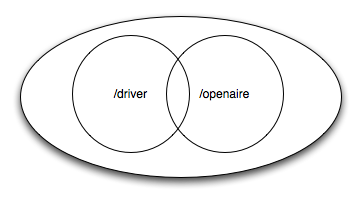
At this stage, contexts could be seen as sets (also defined in the basic OAI-PMH protocol). The magic of XOAI happens when one need specific metadata format to be shown in each context. Metadata requirements by Driver slightly differs from the OpenAIRE ones. So for each context one must define its specific transformer. So, contexts could be seen as an extension to the concept of sets.
To implement an OAI interface from the XOAI core library, one just need to implement the datasource interface.
OAI 2.0
OAI 2.0 is deployed as a part of the DSpace server (backend) webapp. OAI 2.0 has a configurable data source, by default it will not query the DSpace SQL database at the time of the OAI-PMH request. Instead, it keeps the required metadata in its Solr index (currently in a separate "oai" Solr core) and serves it from there. It’s also possible to set OAI 2.0 to only use the database for querying purposes if necessary, but this decreases performance significantly. Furthermore, it caches the requests, so doing the same query repeatedly is very fast. In addition to that it also compiles DSpace items to make uncached responses much faster.
Details about OAI 2.0 internals can be found here.
The OAI 2.0 Server only uses Solr for its indexing. The previous capability to use Database indexing has been removed.
Indexing OAI content
OAI 2.0 uses Solr for all indexing of content.
The Solr index can be updated at your convenience, depending on how fresh you need the information to be. Typically, the administrator sets up a nightly cron job to update the Solr index from the SQL database.
OAI Manager
OAI manager is a utility that allows one to do certain administrative operations with OAI. You can call it from the command line using the dspace launcher:
Syntax
[dspace]/bin/dspace oai <action> [parameters]
Actions
- import Imports DSpace items into OAI Solr index (also cleans OAI cache)
- clean-cache Cleans the OAI cache
Parameters
- -c Clears the Solr index before indexing (it will import all items again)
- -v Verbose output
- -h Shows an help text
Scheduled Tasks
In order to refresh the OAI Solr index, it is required to run the [dspace]/bin/dspace oai import command periodically. You can add the following task to your crontab:
Note that [dspace] should be replaced by the correct value, that is, the value defined in dspace.cfg parameter dspace.dir .
Client-side stylesheet
The OAI-PMH response is an XML file. While OAI-PMH is primarily used by harvesting tools and usually not directly by humans, sometimes it can be useful to look at the OAI-PMH requests directly — usually when setting it up for the first time or to verify any changes you make. For these cases, XOAI provides an XSLT stylesheet to transform the response XML to a nice looking, human-readable and interactive HTML. The stylesheet is linked from the XML response and the transformation takes place in the user’s browser (this requires a recent browser, older browsers will only display the XML directly). Most automated tools are interested only in the XML file itself and will not perform the transformation. If you want, you can change which stylesheet will be used by placing it into the [dspace]/webapps/oai/static directory (or into the [dspace-src]/dspace-xoai/dspace-xoai-webapp/src/main/webapp/static after which you have to rebuild DSpace), modifying the "stylesheet" attribute of the "Configuration" element in [dspace]/config/crosswalks/oai/xoai.xml and restarting your servlet container.
Metadata Formats
By default OAI 2.0 provides 12 metadata formats within the /request context: