SWIFT GPI
Международная инициатива SWIFT по внедрению инновационной системы в области международных расчетов (gpi) значительно улучшает качество обслуживания клиентов при осуществлении международных платежей за счет повышения скорости, прозрачности и непрерывного отслеживания международных платежей.
На сегодняшний день более 660 финансовых институтов присоединились к инициативе gpi по всему миру. Тысячи международных платежей уже осуществляются с помощью нового стандарта, что дает банкам и их корпоративным клиентам неоспоримые преимущества.
SWIFT gpi направлен на улучшение расчетов между юридическими лицами. Инициатива создана для того, чтобы помочь компаниям развивать международную деятельность, улучшать отношения с поставщиками и совершенствовать контроль денежных потоков. Благодаря инициативе SWIFT gpi компании уже сегодня получают целый ряд возможностей в области расчетных услуг, такие как:
- зачисление средств в день платежа
- прозрачность комиссий
- непрерывное отслеживание платежей, где они находятся и на какой стадии исполнения
- информация о денежных переводах остается неизменной
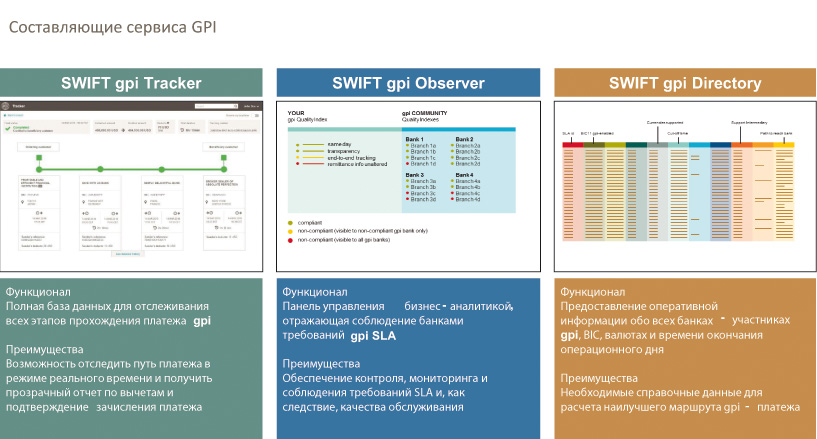
SWIFT gpi функционирует на основании ряда бизнес-правил, предусмотренных в многосторонних соглашениях об уровнях обслуживания (SLA), которые должны соблюдаться банками-участниками. Новая система создана для удовлетворения потребностей корпоративных клиентов, при этом позволяя самим банкам соблюдать нормативные требования, а также свои обязательства в отношении рыночных и кредитных рисков, а также риска утраты ликвидности. Система построена на надежной и устойчивой международной платформе SWIFT. Участником может стать любое регулируемое финансовое учреждение (группа 1 в системе SWIFT), которое входит в сообщество SWIFT и соблюдает предусмотренные инициативой правила ведения бизнеса.
В рамках внедрения gpi, SWIFT представляет специальные условия подписки на этот сервис для малых и средних пользователей, имеющих трафик до 300 сообщений в день.
ВОПРОСЫ и ОТВЕТЫ
1. В чем ключевые отличия технологии gpi от классической системы?
2. В чем заключаются преимущества для банков и клиентов?
3. Сравните стоимость двух систем для банков?
4. Как много банков уже подключились к gpi?
5. Сколько транзакций (количество и объем) уже прошли по gpi?
6. Одно из преимуществ технологии gpi – это возможность отслеживания транзакции на всем пути от отправителя до получателя. Как это работает на практике?
7. Как влияет участие в gpi на построение платежной цепочки?
8. Насколько быстрее обрабатываются платежи? Какие обязательства по скорости обработки появляются у банка, присоединившегося к сервису? Должно ли это проиcxодить мгновенно?
9. Как SWIFT gpi помогает соответствовать комплаенсу?
10. Существуют ли какие-либо ограничения по валютам? Можно ли включить рублевый платеж в gpi?
По вопросам, связанным с подпиской на сервис SWIFT gpi, а также о специальных условиях для российского сообщества, обращайтесь, пожалуйста, в РОССВИФТ. Контактные лица: Ольга Свирина, Алсу Миннибаева.
What are SWIFT gpi Payments?
SWIFT gpi is the new standard in cross-border payments. Every business needs faster ways to transfer money and SWIFT gpi aims to improve speed, reduce costs, and increase transparency in international payments. Read more about SWIFT gpi payments and their benefits in this blog.

Faster cross-border payments are the lifeline of any business that operates across multiple countries. Whether it be receiving payments from customers, or paying suppliers and employees on time, every business needs faster ways to transfer money. That is where SWIFT gpi comes in as a handy solution.
What is a SWIFT payment?
SWIFT is a secure payment messaging network that is widely used for international payments. It is the primary interbank messaging service for financial institutions around the world. Over $150 trillion in transactions happen every year over the SWIFT network. But earlier SWIFT standards came with issues such as delayed payments, lack of visibility on funds once they have been sent, and high routing fees (which meant lesser money into the recipient’s account). To solve these problems, SWIFT has launched a new initiative, SWIFT gpi. A number of large financial institutions across the world now offer services that use SWIFT gpi protocols.
What is a SWIFT gpi payment?
SWIFT gpi (gpi stands for Global Payments Innovation) is the newest initiative from SWIFT that aims to improve the experience of making payments via the SWIFT network, for both customers and banks. SWIFT gpi combines the traditional SWIFT messaging and banking system with a new set of rules. This includes end-to-end payment tracking, greater transparency in fees, and payment confirmation when money is credited into a recipient’s account. The new standard aims to meet the demands of businesses and consumers for better pricing, speed, and greater transparency in international payments.
Over 4000 financial institutions are members of SWIFT gpi, processing over $300bn a day. Over 150 currencies are used to send gpi payments. Over 75% of all SWIFT payments are sent via gpi. With SWIFT gpi, parties can send and receive funds quickly and securely to anyone, anywhere in the world. They can track a payment status in real-time and know where their payment is at any point in time. SWIFT gpi makes cross-border payments much easier across banking networks. This helps ensure speed, certainty, and a seamless cross-border payments experience.
What are the benefits of SWIFT gpi?
The main benefits of SWIFT gpi are speed, tracking, accuracy, and transparency.
- Increased payment speed – SWIFT gpi comes with better messaging standards which improves communication between banks, leading to faster payments
- Higher transparency due to end-to-end tracking – All payments made via SWIFT gpi have a Unique End-to-End Transaction Reference (UETR) which helps pinpoint where the funds are in real-time. Businesses and their customers have real-time access to payments data, at any time.
- Greater transparency of fees and charges – Member banks of the SWIFT gpi network must provide full clarity on processing fees and times. This enables businesses and consumers to make better decisions and helps banks improve payments routing.
- Helps maintain complete data records – SWIFT gpi guarantees that 100% remittance data is sent with payments without any changes throughout the payments journey. This helps recipient parties to easily reconcile payments with invoices or orders.
How can businesses use SWIFT gpi?
Speak to your payment service provider to enable payments through SWIFT gpi. A global PSP like Novalnet can advise you on what steps you need to take and help you address your payments-related challenges. We are a trusted partner for global brands. Our state-of-the-art technologies – from instant payment plug-ins to AI-based risk management tools – have been helping Europe’s leading brands solve complex payment challenges and delight customers.
Reach out to us today to know more.
Jose Augustine is the Chief Business Development Officer at Novalnet with extensive experience in European payment industry and a knowledge powerhouse.
Статусы в GPI-трекинге платежа
GPI-трекинг SWIFT платежа можно, как правило, заказать в банке-отправителе или попробовать поискать здесь если у Вас есть UETR или референс номер платежа.
ACCC — финальный статус платежа, зачисление на счёт получателя. Статус перевода больше не поменяется в трэкере.
ACSP — accepted, settlement in progress — платёж находится в обработке.
ACSP/G000 — платёж передан банку, являющемуся участником SWIFT GPI.
ACSP/G001 — платёж передан банку, не являющемуся участником SWIFT GPI.
ACSP/G002 — pending credit may not be same day, ожидается зачисление, но возможно не в тот же день. Фактически означает, что платёж на проверке.
ACSP/G003 — платёж ожидает необходимых документов. Может быть признаком неправильных реквизитов, проверьте и сделайте уточнение через банк-отправитель. Если банк запросил документы, но не знаете какие лучше предоставить — проконсультируйтесь с нашими экспертами.
ACSP/G004 — ожидает перевода покрытия.
RJCT — платёж отклонён банком. Статус перевода больше не поменяется в трэкере.
Как опеределить в каком банке платёж? Если у Вас нет расширенного трекинга — достоверно определить не удастся. Просто по статусу «Pending credit may not be same day» — определить банк не получится, это может быть любой из банков-корреспондентов или уже банк-получатель. Подробнее как найти где находятся деньги здесь.
При этом Вы можете восстановить цепочку перевода (а лучше всегда её просто заранее моделировать, чтобы не было сюрпризов) в Планировщике маршрута перевода.
Отправляли недавно swift-перевод? Расскажите анонимно дошёл ли он и за какое время. Это позволит другим пользователям не совершать лишних ошибок.
Подпишитесь на новости SWIFT-переводов и релокации капитала @ohmyswiftblog
What Is SWIFT?

Swift is the global financial artery that allows the smooth and rapid transfer of money across borders. It stands for Society for Worldwide Interbank Financial Telecommunication.
How does SWIFT work?
Banks in the SWIFT system have a code or number that will be explained below, which will identify them.
Say you want to send a wire transfer through SWIFT to someone living in New York, To make that payment, you’ll need a slew of information, including the amount being sent and the United States bank's SWIFT code, Your bank will send that information, and once the receiving bank gets that information, it will deposit the money.
Later, the two institutions will settle the payment, with means they’ll adjust the account balance to reflect the transfer.
“It is just a system by which financial institutions communicate with each other,”.
Who Uses SWIFT Payments?
n the beginning, SWIFT was created to facilitate communication about treasury and correspondent transactions only. The functionality of the message format design allowed for large scalability. SWIFT gradually expanded to provide services for:
• Banks
• Clearing systems
• Money brokers and security broker-dealers
• Corporates
• Non-bank financial institutions
• Treasury market participants
• Asset management companies
• Foreign exchange
SWIFT Services
The SWIFT system offers many services that will help you send seamless, international transactions
- Business Intelligence
- Compliance Services
- Messaging and Connectivity
- Global Payment Innovations
Architectures
With the goal of determining the system components concerned, in addition to the organizational aspects (e.g. company or third party roles involved), within the perimeter on which insists the application of security controls (secure zones), SWIFT requires entities to identify which of the five reference architectures, is closer to what is deployed in their operating environment for message transmission and reception.
With the Customer Security Programme (CSP), SWIFT classifies reference architectures through the identification of interfaces, applications and tools, specifying how different implementations can however be characterized by a substantial level of customization, compared to the groups identified below:
A1 architecture: ownership of license and use of the communication interface and the messaging interface, or of the communication interface only, which typically reside within the premises of the Organization or at the service provider.
Architecture A2: ownership of license and use of the messaging interface only, located at the Organization or at a service provider.
A4 architecture: use of a custom connector, typically using an application solution (e.g. file transfer or middleware such as IBM MQ Server) that allows communication with a service provider.
Architecture B: no specific infrastructure components. The messaging service is used via a PC or other device through a Graphical User Interface (GUI) or through a back-office application through the Application Programming Interface (API) that connects to services provided by a service provider.
What are the advantages of a CSP architecture type?
Architecture A1:
- Alliance Access + Alliance Gateway (Instant)
- Alliance Messaging Hub (instant) + Alliance Access
- Other Messaging Interface + Alliance Gateway (Instant)
- Alliance Gateway (instant) only
Architecture A2:
- Alliance Access as part of Alliance Remote Gateway (ARG) solution
Architecture A3:
- Alliance Lite: AutoClient or AutoClient + GUI
- Alliance Lite: AutoClient
- SWIFT Alliance Lite 2: SWIFT AutoClient or SWIFT AutoClient + GUI
- CFS (Connector For Sanctions) for IPLA or SIL
- T2S Connector (TARGET2-Securities)
- GPI (Global Payments Innovation) Connector
- DirectLink
- FTP like solutions for communication with the Alliance Access or the Alliance Gateway
- Middleware solutions (such as MQ) to connect to the Alliance Access of a service provider
- No Access or Gateway but share the Alliance owned by an ARG Customer (A3 or B)
Architecture B:
- Alliance Lite: GUI
- Alliance Lite 2: GUI
- SOAP/API to connect to the Alliance access of a service provider
- GUI only for WebAccess (formerly Browse) services
- GUI for manual message / file entry (no Alliance Access or Gateway)
- Users of an Alliance Lite2 for Business Applications (L2BA) Provider
- Clients connecting to SWIFT for Single Market Infrastructure Gateway (ESMIG) User to Application (U2A) only
- No Access or Gateway but share the Alliance owned by an ARG Customer (A3 or B)
The following architecture type A1 in a diagram describe SWIFT A1 components(messaging interface, communication interface, RMA etc) which are controlled by the organization.
About SWIFT
SWIFT is the shortcut of :
- Society for
- Worldwide
- Interbank
- Financial
- Telecommunication
239 BANKS revolutionised the way they communicate with each other
SWIFT has four components
- Platforms
- Standards
- Community
- Product and services
What does SWIFT offer?
SWIFT carries your data and messages over a highly secure, reliable and resilient platform
Using industry standards that ensure seamless communication.
SWIFT provides a network for financial intuitions to exchange services.
Why does SWIFT exist?
- SWIFT evolves, Today, more institutions types connect to SWIFT, not only banks :
- Securities players: brokers dealers, investment managers, custodians and fund administrators
- Market Infrastructures: central banks, central securities depositories, exchanges and clearing houses
- Corporates: large groups or smaller companies
A range of services has evolved to meet the needs of a global community
Today, SWIFT serves the global financial community in a wide variety of business areas.
- Financial messaging
- Payments & cash management
- Securities pre-trade and trade
- Corporate actions
- Treasury management
- Trade services
- Clearing and settlement
SWIFT Messaging Services
BIC
BIC structure (ISO 9362:2014)
- BIC is:
An 8-character code. when only the element business party is applied.
An 11-character code when both elements business party and branch are applied.
- A business party identifier is mandatory and assigned by the registration authority.
- The branch identifier is optional and assigned by the registration authority if requested.
SWIFT Corporates
- Since 2007 corporates had the possibility to join SWIFT and be part of the global financial community.
- Corporate connected to SWIFT is able to send and receive standardized financial messages with their financial institution in a highly and reliable manner.
- Business areas that are available for a corporate:
- # Payment and Cash Management
- # Securities
- # Trade Finance and Supply-chain Finance
Payment and Cash Management
SWIFT MT101 Message
The SWIFT MT101 message is a request for transfer, enabling the electronic transfer of funds from one account to another. Funds are transferred from ordering customers' accounts to a receiving financial institution or account servicing financial institution. For us right now, the important thing to note is that the message format that enables this transfer is the SWIFT MT101 format.
SWIFT 900 Series Messages
MT 900: Confirmation of Debit
MT 910: Confirmation of Credit
MT 920: Request Message
MT 935: Rate Change Advice
MT 940: Customer Statement Message
MT 941: Balance Report
MT 942: Interim Transaction Report
MT 950: Statment Message
MT 970: Netting Statment
MT 971: Netting Balance Report
MT 972: Netting Interim Report
MT 973: Netting Report Message
MT 985: Status Inquiry
MT 986: Status Report
MT 990: Advice of Charges, Interest and Other Adjustments
MT 991: Request for Payment of Charges, Interest and Other Expenses
MT 992: Request for Cancellation
MT 998: Proprietary Message
MT 999: Free Format Message
Foreign Exchange and Money Markets
Securities -Financial Bonds -Holdings
Trade Finance Flow on SWIFT
We will go through this scenario to explain how the foreign exchange confirmation SWAP using MT 300
Alliance Access Integration Platform (IPLA)
Is an optional tool for communication between users’ back-office systems and SWIFT. It supports different message formats and can contact other systems for data validation and enrichment.
SWIFT Integration Packages.
Alliance Access Integration Packages combine one or more software adapters with a SWIFT integration platform: either the integration capability built into Alliance Access Integration Platform (IPLA), or the standalone in the SWIFT Integration Layer (SIL).
Two different integration packages are available. The Standard Integration Package is an entry-level package for straightforward connectivity needs. For organisations with more complex requirements, the Full Integration Package provides all the tools necessary to implement any new integration with SWIFT
Standard Integration Package
When files need to be automated in ‘batch’ mode only, our entry level package is likely to be the most suitable option. Meeting straightforward connectivity needs, the Standard Integration Package provides automated file transfer (AFT) on Alliance Entry and Alliance Access.
- Message files are supported.
- All Alliance Access file formats are supported: FIN/RJE, MX/XMLv2, DOS-PCC and FileAct.
- As a fixed-price package, the Standard Integration Package offers predictable costs. The package is priced independently of traffic volumes and Alliance Access Banks and is not subject to band upgrades.
Suitable for applications which can produce files formatted precisely for Alliance Access — including headers — the Standard Integration Package does not support interactive protocols such as MQ, customisations or the Direct FileAct function, whereby FileAct files are submitted without header information.
Full Integration Package
Suitable when changes to the back office will affect the integration between back office applications and SWIFT, the Full Integration Package provides all the tools needed to implement any new integration with SWIFT. This comprehensive package supports the changing needs of organisations with a more complex systems infrastructure, with the added benefit of predictable costs.
The Full integration Packages combine the integration capabilities of either Alliance Access Integration Platform (IPLA) or SWIFT Integration Layer (SIL) with adapters enabling communications with the relevant business applications. Included in the package are:
- All adapters: AFT, Direct FileAct, MQ-HA, SOAP-HA and web services.
- All interactive protocols: MQ, SOAP, REST and JDBC.
- All file-based protocols: FIN/RJE, MX/XMLv2, DOS-PCC, FileAct and Direct FileAct.
- All capabilities of IPLA and SIL, such as transformations and message and file construction.
This package also allows organisations to install and customise other SWIFT solutions such as Sanctions Screening and T2S.
What is SWIFT gpi?
SWIFT gpi is a stander for Global Payments Innovation, which is new initiative from SWIFT and was developed to improve the experience of making a payment via the SWIFT network for both customers and banks.
SWIFT gpi combines the traditional SWIFT messaging and banking system with a new set of rules. Any bank that joins GPI has to follow these rules, which include transparency of fees, end-to-end payment tracking, and confirmation of credit to the recipient’s account.
What are the benefits of SWIFT gpi?
To increase payment speed
Improvements in communication and higher standards for banks mean that payments will be quicker when made through the SWIFT gpi network
To provide end-to-end tracking
All payments have a Unique End-to-End Transaction Reference (UETR) which can be used to check the location of the funds at any point in their journey, in real-time.
To improve the transparency of fees and charges
Banks who are part of the gpi network are required to provide full visibility on processing fees and times, which will enable individuals to make better decisions and allow banks to improve routing.
To maintain consistent data records
Gpi guarantees that all remittance data that is sent with payments will be unaltered throughout the whole payments journey. This allows recipients to easily reconcile payments against invoices or orders.
SWIFT for Open Banking Innovation
SWIFT has published a new API standard for the pre-authorisation of funds in an effort to bring more innovation to open banking located in Europe.