Welcome to the Stock Plan Resource Center
Easily understand how to get started with your stock plan—including managing your Stock Plan Account, selling shares, and accessing your cash.
- Home
- Stock plan award information
- ESPP information
Getting set up in your stock plan and managing your Stock Plan Account
Getting started in your stock plan
Selling shares and accessing cash
Maintaining your account
Never miss important updates
Be sure to keep your email address and phone number current so we can keep you informed about important updates. You can manage this information and more in your account Profile in Fidelity NetBenefits.
Quick links to common activities

Account certification FAQs (PDF)
Learn more about completing Form W-8BEN—a requirement for nonresident aliens not subject to US tax withholding.
Stock plan glossary
What’s that word? Find definitions for commonly used terms.
Investing involves risk, including risk of loss.
Fidelity Stock Plan Services, LLC, provides recordkeeping and/or administrative services to your company’s equity compensation plan, in addition to any services provided directly to the plan by your company or its service providers.
Log in to NetBenefits.com 
Important Information
Keep in mind that investing involves risk. The value of your investment will fluctuate over time, and you may gain or lose money.
what is a stock plan services account

It’s more than just a place where stock plan shares and cash are held—it’s a full-feature brokerage account that helps you save, spend, and invest. You can deposit money, invest in a wide range of investments for potential growth, or tap into your cash by using an ATM/debit card, writing a check, and even paying bills online.
How to contact Fidelity stock plan services representative?
Contact Fidelity regarding your account by phone or online. Interested in opening an account? 800-FIDELITY (800-343-3548). Brokerage, Mutual Fund, and IRA Account questions? 800-544-6666.
How to buy stocks without a brokerage account?
Know how DSPPs work.
- DSPPs are generally available from large, well-established companies.
- You can agree to automatic monthly withdrawals from your checking or savings account to purchase more stocks.
- A transfer agent is a third party that represents the company. It may be a bank, a trust company or a similar organization. .
What is a stock plan account?
Your stock plan account1
- View the value of your stock plan holdings
- Make plan elections
- Exercise options or sell stock plan shares
- Access information and plan documents
How to invest using direct stock purchase plans?
- Determine what stock you want to buy.
- On the “investors” page of that company’s website, look for an FAQ link.
- In the list of FAQs, find one that regards either buying stock directly from the company or a dividend reinvestment plan.
What is stock plan services account in Fidelity?
Your Fidelity Account® is where your stock plan shares and cash will be held when your awards pay out or when you make a purchase through an ESPP. It’s a brokerage account with lots of convenient features. You can manage your cash using an ATM or debit card, online bill paying, checkwriting, or money transfers.
Are employee stock purchase plans worth it?
Are ESPPs good investments? These plans can be great investments if used correctly. Purchasing stock at a discount is certainly a valuable tool for accumulating wealth, but comes with investment risks you should consider. An ESPP plan with a 15% discount effectively yields an immediate 17.6% return on investment.
What is a stock plan brokerage account?
A brokerage account is an investment account that allows you to buy and sell a variety of investments, such as stocks, bonds, mutual funds, and ETFs. Whether you’re setting aside money for the future or saving up for a big purchase, you can use your funds whenever and however you want.
How does a employee stock purchase plan work?
An ESPP allows you to purchase company stock at a discounted price, often between 5-15% off the fair market value. For example, if the fair market value on the applicable date is $10 per share, and your plan offers a 15% discount, you can purchase those shares for $8.50 per share.
What happens to my ESPP when I quit?
With employee stock purchase plans (ESPP), when you leave, you’ll no longer be able to buy shares in the plan. Depending on the plan, withholding may occur for months before the next pre-determined purchase window.
Can I cash out my ESPP?
A: Yes. You may withdraw from the ESPP by notifying Fidelity and completing a withdrawal election. When you withdraw, all of the contributions accumulated in your account will be returned to you as soon as administratively possible and you will not be able to make any further contributions during that offering period.
Can you lose money in a brokerage account?
People lose money in brokerage accounts all the time. And often, that boils down to making poor investment choices, or making good choices that just don’t happen to work out well.
What are the 3 types of brokerage accounts?
Types of Brokerage Accounts Traders Should KnowCash accounts. The traditional brokerage account is a cash account, which also is known as a Type 1 account. . Margin accounts. You don’t have to have as much cash on hand to buy stock when you open a margin account. . Options. . IRAs and other retirement accounts.
Is a brokerage account better than a savings account?
Brokerage accounts often carry higher risks and costs, but much higher earning potential. On the flip side, savings accounts bring certainty and immediate access to all of your funds at a moment’s notice.
Why do companies offer employee stock purchase plans?
Create an ownership culture in your company An ESPP is the easiest and often the most cost-effective way for employees to purchase shares in the company. When employees are also owners, they have a greater stake in the success of the company, which can be a powerful motivator and reduce turnover.
How much should I put in my employee stock purchase plan?
If you haven’t ever contributed to your company’s ESPP before, select a percentage of your pay that feels comfortable (maybe 1-5% of your salary). This will help you get acquainted with how ESPPs work and will give you confidence to increase the percentage later.
Should I max out my employee stock purchase plan?
Most people who have access to an Employee Stock Purchase Plan should definitely use it, max it out, and flip it immediately. Doing so will almost guarantee an almost 30% annual return on your money.
Is it better to invest in 401k or ESPP?
The no-match 401(k) is significantly better than the ESPP. The tax arbitrage in the 401(k) translates into a 7.04% IRR. Pretty impressive, because the net-of-fees equity return is only 5.90%, so you gain a full 114 basis points (1.14 percentage points) in annual returns from the tax arbitrage.
How much should I put in employee stock purchase plan?
#11 How much should I put in an employee stock purchase plan? You can contribute 1% to 15% of your salary, up to the $25,000 IRS limit per calendar year. The more disposable income you have, the more you can afford to put in an employee stock purchase plan.
Should I max out my employee stock purchase plan?
Most people who have access to an Employee Stock Purchase Plan should definitely use it, max it out, and flip it immediately. Doing so will almost guarantee an almost 30% annual return on your money.
Why do companies offer employee stock purchase plans?
Create an ownership culture in your company An ESPP is the easiest and often the most cost-effective way for employees to purchase shares in the company. When employees are also owners, they have a greater stake in the success of the company, which can be a powerful motivator and reduce turnover.
What type of stock plan do I have and how does it work?
A stock plan is a benefit that companies provide to grant their employees the ability to receive or purchase shares of company stock as part of emp.
How do I open my account?
Opening your Fidelity Account ® is a simple but important step in setting up the future home of your shares. This account is where you can manage.
How do I get my cash?
If you sold shares, exercised an award, or received a payout, there are several easy ways to access your cash directly from your Fidelity Account ®.
How is my stock plan affected by taxes?
Shares of stock received or purchased through a stock plan are considered income and generally subject to ordinary income taxes. Additionally, when.
How do I accept my award?
Some companies require awards to be accepted. To accept an award, simply click Begin Acceptance on your Stock Plan Summary page Log In Required.
How do I enroll in my employee stock purchase plan (ESPP)?
If you’re eligible and the enrollment window is open, you’ll see Enroll next to your ESPP’s name when you log in to NetBenefits ® Log In Required.
What type of stock plan do I have, and how does it work?
A stock plan is a benefit that companies provide to grant their employees the ability to receive or purchase shares of company stock as part of emp.
What are my plan documents, and where can I find them?
Your plan documents are issued by your company and provide details about how your stock plan works. You can view these documents by selecting Plan.
What is the difference between Fidelity.com and NetBenefits.com?
You can access your stock plan information through two different sites: Fidelity.com and NetBenefits.com . Both sites are part of Fidelity Inves.
What is my Fidelity Account®, and how does it work?
Your Fidelity Account ® is where your stock plan shares and cash will be held when your awards pay out or when you make a purchase through an ESPP.
How do I open my account?
Opening your Fidelity Account ® is a simple but important step in setting up the future home for your shares. This account is where you can manage.
Can I view my information on a tablet or smartphone?
Yes, you can view your account information, place trades, and even move money on a tablet or smartphone by downloading the Fidelity Mobile® app. Le.
How do I sell my shares?
Once your shares are available in your Fidelity Account ® , you can sell them online or with the Fidelity Mobile ® app. Simply log in to your acco.
How do I get my cash?
If you sold shares, exercised an award, or received a payout, there are several easy ways to access your cash directly from your Fidelity Account ®.
What types of communications will I receive from Fidelity?
Fidelity Stock Plan Services has been chosen by your company to administer your stock plan. You may receive a range of communications to help you u.
What is a stock brokerage account?
It’s more than just a place where stock plan shares and cash are held —it’s a full-feature brokerage account that helps you save, spend, and invest. You can deposit money, invest in a wide range of investments for potential growth, or tap into your cash by using an ATM/debit card, writing a check, and even paying bills online.
What is fidelity account?
Your Fidelity Account works alongside your company’s stock plan to hold your shares and cash. When it comes to accessing your account, you have optional choices—including an ATM/debit card, money transfers, online bill paying, and checkwriting. You can also leave your cash in your account and invest it for potential future growth.
What is dividend in Fidelity?
A dividend is a payment made by a company to share its profits with its shareholders. If your company stock pays a dividend, it goes into your Fidelity Account ® as cash by default. But you could use that money to purchase more shares of company stock or other investments to help keep it invested and working for you.
Can you sell shares to get cash?
Looking to make a purchase soon? Or planning for something further down the road? You can sell shares to get cash to use now— or invest that cash and potentially grow it for something special in the future.
What is stock plan?
A stock plan is a benefit that companies provide to grant their employees the ability to receive or purchase shares of company stock as part of employee compensation . These plans can come in all shapes and sizes, so to learn more about what you have and how it works, choose your plan type below:
How to view stock plan documents?
You can view these documents by selecting Plan Information and Documents from the Quick Links drop-down menu on NetBenefits ®.
What is fidelity account?
Fidelity.com is where you can view your personal account details and manage your shares or cash after they have been distributed to you by your stock plan. Your Fidelity Account® is where you can act on the proceeds of your plan, such as selling shares, moving money, or transferring assets.
How to sell shares on Fidelity?
Once your shares are available in your Fidelity Account ®, you can sell them online or with the Fidelity Mobile ® app. Simply log in to your account at Fidelity.com, click Trade under Account & Trade on the navigation bar at the top of the home page, and follow the stepby- step prompts.
How to accept an award on a stock plan?
To accept an award, simply click Begin Acceptance on your Stock Plan Summary page Log In Required and follow the step-by-step instructions. You can also review the Accepting your grants online (PDF) quick-start guide if you have any additional questions.
How to access Fidelity cash?
You can link a bank account, set up checkwriting, or use a debit card.
What is a giving account at Fidelity?
A Giving Account ® at Fidelity Charitable ® is a tax-efficient strategy for donating your shares to charity. Compared with selling your shares and contributing the after-tax cash, donating your stock directly to charity may help you potentially avoid paying capital gains tax on the sale of stock while increasing the impact of your charitable donation at the same time.
What is fidelity account?
The Fidelity Account is an all in one brokerage account offering cash management services, planning and guidance tools, online trading, and a wide range of investments like stock, bonds and mutual funds. Use the Fidelity Account as a gateway to investment products and services that can help meet your needs. Learn More.
Can you see Fidelity plans online?
If Fidelity manages your company’s plan, you can see and manage your options online.
When is a stock option in the money?
a stock option is «in the money» when the current market price of your company stock is above the grant price
What is the grant price of a stock option?
the price per share that you must pay to your company to exercise the stock option; the grant price may also be referred to as the exercise price
How long can you sell unregistered stock?
rule permitting the sale of unregistered securities in the open market, provided that the shares were issued under a company benefit plan or compensation agreement prior to a company going public; an owner of these securities who is not considered an affiliate of the issuer may sell shares under Rule 701 (g) (3) without having to satisfy Rule 144 requirements; the shares cannot be sold until 90 days after the company goes public; however, certain Rule 701 paperwork needs to be completed by the stock owner in order to have the restricted legend removed and to release proceeds from the sale; affiliates must satisfy all the requirements of Rule 144, other than the one-year holding period
What is exercise in stock?
exercise. allows you to capture the value between the grant price and the current trading price of your company stock, paying out in either cash or shares, depending on exercise methods allowed by the company. exercise and hold. exercise and hold.
Do you have to sell shares to exercise an option?
an option to elect to receive shares at the time of exercise to cover the option’s cost and required tax withholding; this option will allow you to avoid using any of your own cash during the exercise, and there is no need to sell shares in order to cover costs and taxes
Start investing with your linked brokerage account
We offer a mix of investment solutions to help meet your financial needs–short and long term.
Bring your retirement assets under one roof
It’s easier to manage your money when it’s all in one place. At E*TRADE, you can roll over a former employer plan to an IRA.4
Tap into professional money management
E*TRADE Capital Management can build a portfolio customized to your needs.
Our technology lightens your workload
Schwab EquiView ® is our flexible platform that allows you to manage your program the way that makes sense for you. Think automation of repeatable tasks, fully customizable reports, data how you want to see it, and integration with systems you already use.
Of course we’ll support you. We know your name
From day one, your go-to Schwab contact will be available to help you take full advantage of the tools that make your job easier. No ticket numbers and no bots. Just good, old-fashioned conversations.
Thinking IPO or DPO? We help with those, too
We’ve traveled the public offering road a lot. So we know what bumps to look out for along the way. Lean on our dedicated team when it’s time to take your company public.
How much lower is the discount rate on stock?
With employee stock purchase plans, the discount rate on company shares depends on the specific plan but can be as much as 15% lower than the market price. ESPPs may have a “look back” provision allowing the plan to use a historical closing price of the stock. This price may be either the price of the stock offering date or the purchase date – often whichever figure is lower.
What is an ESPP?
An ESPP is a program in which employees can purchase company stock at a discounted price. Employees contribute through payroll deductions, which build until the purchase date. The discount can be as much as 15% in some cases.
How are ESPPs taxed?
In general, qualifying dispositions are taxed during the year of the sale of stock. Any discount offered to the original stock price is taxed as ordinary income, while the remaining gain is taxed as a long-term capital gain. Unqualified dispositions can result in the entire gain being taxed at ordinary income tax rates.
When does ESPP start?
Participation in the company ESPP may only commence after the offering period has begun. This period begins on the offering date, and this date corresponds with the grant date for the stock option plans. The purchase date will mark the end of the payroll deduction period. Some offering periods have multiple purchase dates in which stock may be purchased.
What to do if your employer offers an employee stock purchase plan?
If your employer offers an Employee Stock Purchase Plan, and you are not participating already, in most cases, you should immediately stop what you are doing and go enroll!
What is the discount rate for stocks?
For most employers, you can expect that discount to range between 5%-15% —obviously the higher the better for you! These shares can then be sold immediately (known as a “Quick Sale”) locking in a tidy and risk-free profit.
What is lookback provision?
The lookback provision is a fantastic benefit as it either magnifies your gain under a rising share price scenario or with a falling share prices still allows you to buy the shares at a discount to the current market value (and sell immediately, if desired, to lock in this gain, known as a “Quick Sale”).
How long do you have to hold on to ESPP shares?
You must hold onto the shares for at least another year after the purchase date and run the risk that the price of the shares drop. Unless you’re intentionally trying to accumulate shares of your company stock, the tax benefits of ESPP shares are not an area where you have an advantage.
What is an ESPP?
Offered by most publicly traded companies, an ESPP is an employee benefit that allows you to purchase shares of your company stock at a discount. It’s this discount that’s the most significant advantage of Employee Stock Purchase Plans. For most employers, you can expect that discount to range between 5%-15%—obviously the higher the better for you! .
How much can you contribute to an ESPP?
Under an ESPP program, employees can elect to defer salary and bonus up to the IRS limit of $25,000 per year (the “ Contribution Limit” ). You elect how much to contribute per pay period during an initial “ Enrollment Period”. At the end of this enrollment period, typically every six months, this money is used to purchase shares at a discount .
What happens at the end of a stock purchase?
At the end of the period, on the purchase date, the money will be used to purchase shares of your company stock at a discount to their market value.
Fidelity Investments Review

In this Fidelity review, I aim to provide you with an informative, impartial assessment of the Fidelity investment platform, based on my own findings and experiences, so you can make an educated decision about whether this is the best trading platform to meet your unique requirements. Over the course of this Fidelity review I have made every effort to highlight not only the positives about Fidelity, but also any negatives that I have come across when downloading and using the platform.
I also look at the products and investment options available at Fidelity including their ISA and SIPP offerings, as well as the charges and fees that you can expect to encounter.
- Fidelity Ratings
- Who is Fidelity Investments
- Fidelity Investments Accounts Available
- Fidelity Investment Options
- Fidelity Platform Review
- Fidelity Research Services & Tools
- Fidelity Fees & Charges
- Opening an Account with Fidelity
- Transferring Your Investments to Fidelity
- Fidelity ISA Review
- Fidelity SIPP Review
- Customer Support
- Fidelity International Review Bottom Line
- Useful Information
- Fidelity FAQs
- Fidelity Customer reviews
Fidelity Investments set up shop in 1946 and in 1969 launched Fidelity International, servicing clients in the UK and Europe.. With clients around the world, Fidelity is a well-known global brand which has continued to grow with the recent acquisition of the Legal and General personal investing business in the autumn of 2020.
They are more a traditional ISA and SIPP provider and not necessarily a sort of digital maverick. Their 50-years of experience explains why Fidelity still offers personalised services, like phone service, in person meetings, and access to relationship managers as well as their online investment platform, even for clients who have less than five figures in their accounts.
Fidelity Ratings
- Easy to use trading platform
- Excellent research tools
- Competitive fund fees and non-trading fees
- Limited selection of products
- No electronic wallets available
- High minimum deposit

Who is Fidelity Investments
Fidelity Investments is a brokerage firm providing a wide range of stocks, bonds and mutual funds to retail investors through retirement and non retirement accounts. Established in 1946 as a mutual fund company, Fidelity Investments launched their international arm in 1969 which today services more than 2.5 million users across the globe.
Who Owns Fidelity Investments?
Fidelity Investments is privately owned by CEO Abigail Johnson and her family that owns 51% of shares, the remaining 49% is owned by current and former employees.
Should you go with a provider who’s ‘Old Dependable’ as your online broker? Or is your investment style better suited to the innovators whose aim is to shake things up? I walk you through Fidelity’s product below.
Fidelity Investments Accounts Available
Fidelity.co.uk offers the standard investment and retirement accounts including:
- Stocks and Shares ISA
- SIPP
- Investment Account including Index Funds and Mutual Funds
- Fidelity Junior ISA
- Junior SIPP
- Cash Management Account
The international arm of Fidelity focuses solely on investment banking and wealth management, so you won’t find traditional savings accounts here, however for US citizens there is the option of Checking Accounts and Credit Cards via a US Fidelity account, similar to TD Ameritrade and Charles Schwab.
The Fidelity Cash Management Account is a holding account, useful for moving money between other accounts and paying fees. Fidelity doesn’t charge any fees for money held in this account and because it’s not invested, your funds will remain the same as opposed to fluctuating with the stock market.
Fidelity also doesn’t accept the transfer of Lifetime ISAs; it provides stocks and shares and Junior ISAs only.
Fidelity Accounts vs Interactive Investor and Hargreaves Lansdown
| Account Type | Fidelity | Interactive Investor | Hargreaves Lansdown |
|---|---|---|---|
| Investment Account | Yes | Yes | Yes |
| SIPP | Yes | Yes | Yes |
| Stocks and Shares ISA | Yes | Yes | Yes |
| Cash ISA | No | No | No |
| Lifetime ISA | No | No | Yes |
| Junior SIPP | Yes | No | Yes |
| Junior Stocks and Shares ISA | Yes | Yes | Yes |
| Cash Management Account | Yes | No | No |
Fidelity Investment Options
Fidelity offer the following investment options:
- Stocks
- ETFs
- Mutual Funds
How does this compare to the competition? Below I have listed the investment options available at Fidelity compared to Interactive Investor and Hargreaves Lansdown.
| Investment Option | Fidelity | Interactive Investor | Hargreaves Lansdown |
|---|---|---|---|
| Stocks | Yes | Yes | Yes |
| ETFs | Yes | Yes | Yes |
| Mutual Funds | Yes | Yes | Yes |
| Forex | No | No | No |
| Bonds | No | Yes | Yes |
| Options | No | No | No |
| Futures | No | No | No |
| CFDs | No | No | Yes |
| Crypto | No | No | No |
As a product portfolio, I found this is a little limited, with no bonds, options trades, futures or CFDs to choose from. Only stocks and ETFs traded on the London Stock Exchange are included which is a thin offering when compared to Interactive Investor or Hargreaves Lansdown, however, the selection of over 3,000 mutual funds is extensive and includes a range of mutual funds provided by BlackRock and Vanguard as well as their own mutual funds.
If you are looking for a mutual fund that allows you to invest in line with ESG principles then Fidelity have a great selection, including the Liontrust Sustainable Future Global Growth Fund which is one of my top picks for best ethical investment fund.
In addition to this, Fidelity offer access to over 180 Investment trusts from various providers as well as a decent range of penny stocks.
Fidelity Platform Review
The desktop platform at Fidelity is well designed and easy to navigate with a two-step login for your security. There is a good level of search functions available to help you locate assets or tickers and these can be filtered to show only mutual funds and investment trusts or ETFs.
I was disappointed to see the lack of alerts and notifications on the desktop platform, however, I’m hoping these will be rolled out in future updates. That being said, the overview of your investments and how they are performing is informative and easy to access.
Active Trader Pro
For active traders who have heard of Fidelity’s Active Trader Pro interface, it provides a more comprehensive set of features which includes charting functionality and trade tools. However, Active Trader Pro is currently only available through Fidelity Investments, the US arm of the business, and investors in the UK can not access this level of usability which seems a shame. I’m hoping Fidelity will correct this and launch Active Trader Pro for active traders in the UK soon.
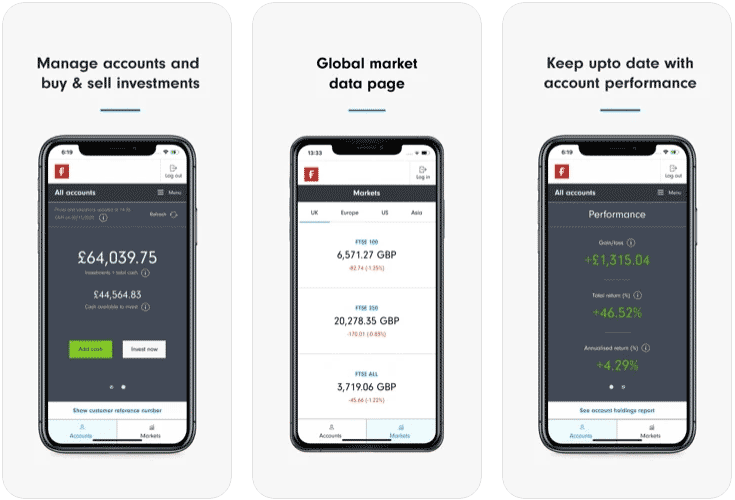
Fidelity Mobile App
Fidelity provides a well designed mobile app that features two-step authentication as well as biometric authentication. Again, I found a distinct lack of alerts which won’t help Fidelity keep up with the competition, however, their speed times have really improved with the latest update which is good to see. Still, I didn’t find the mobile app as slick as some of the other robo advisers out there and getting to the watchlist in order to access portfolio reports is a little arduous. That being said, they are scoring a respectable 4.5/5 from customer reviews on the app store although a lot of users report the lack of landscape format as an issue for the client experience.
Fidelity Research Services & Tools
Fidelity offers a helpful introduction to investing geared towards customers with a focus on retirement planning.
The trading platform provides a combination of retirement planning calculators, introductory videos about investing with fidelity, and guides that promote the ease and value of taking control of your pension via a SIPP account. There’s also a tool that helps you identify the best account for your needs and provides helpful charts to compare investments.
The research tools are geared towards those who aren’t otherwise regular investors and they break down data using easy comparisons — even if you don’t consider yourself someone who is ‘good with numbers.’
We like that they offer more comprehensive views of investments without skipping some of the tools that make their competitors so attractive for first-time investors. For example, the PathFinder tool helps you choose a fund according to your preferred risk and whether you’re looking for growth or income funds.
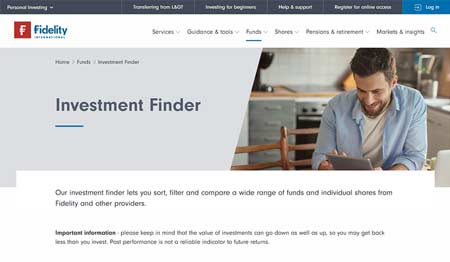
The Investor Finder tool also gives you a road map through other types of personal finance investments offered, including funds, shares, ETFs, mutual funds and investment trusts. Simply choose the investment type that best suits you and then use the filter function to find your ideal match.
For those who are already more involved with their accounts, Fidelity also provides market news, including a daily market review and a regular podcast. The team also delves into investment ideas, personal finance, and insights into the company’s own market perspectives. These published items are useful, and the team of writers are largely veteran journalists with decades of experience in financial reporting, and it shows.
Beyond this, Fidelity has an internal commitment to providing proprietary insights via their online broker investment platform. The scale of the company means that its portfolio managers and financial analysts do their research in the field rather than through an RSS feed of aggregated online news. The in-house research team provides insights on 90% of fund holdings, giving portfolio managers plenty to work with.
In other words, whether you choose to take control of your accounts or put your trust in the hands of one of Fidelity’s advisors, you can be sure that you’ll enjoy a research-focused approach to investing.
Fidelity Fees & Charges
Fidelity charges an annual fee on a tiered structure according to the value of your investment. Although Fidelity claims the account fee structure is simple, it does have more caveats than other services.
Let’s begin with the charges Fidelity doesn’t apply. There are no charges for the following transactions:
- Set-up
- Annual
- Account closure
- Fund switching
- Fund transfer
- Tax relief re-investment into funds
- Exit fees
Fidelity also leaves behind most pension charges, like administrative charges on drawdown accounts, transfer charges, and pension splitting on divorce.
The complications begin once fees are introduced.
For example, accounts valued at less than £7,500 pay £45 a year (or £3.75 a month) in fees. However, the fee changes to 0.35% if you use a monthly regular savings plan and invest £50 a month or more (even if you only have a few thousand pounds in the account).
The fees aim to encourage investors to save regularly, and £50 a month for retirement seems like a small ask. However, it does hurt people who invest in a lump sum, such as through their tax refund or through an inheritance structure, and those who can’t commit to £50 every month.
The next tier is Fidelity’s standard service fee: 0.35% for accounts worth between £7,500 to £249,999.99.
Once you reach £250,000, then you enjoy a significantly lower rate of 0.2% up to £1 million. There’s no further fee assessed on anything above £1 million.
However, the fees differ for Junior ISA and SIPP products: these accounts pay £25 a year on investments under £7,500. Additionally, the £25 fee applies even when you have multiple accounts. So if you have an account with £5,000 and another with £3,000 in it, then you pay £25 per account even though both accounts feature a total of over £7,500.
Fidelity also assesses fund management fees on relevant accounts.
The cost for managing funds begins at 0.06%, and these fees depend on the individual fund’s characteristics to include:
- Bid-offer spread
- Performance fee
- Fund manager buy/sell charge
- Finally, you’ll pay share dealing charges (including investment trusts and ETFs) for each transaction.
Although Fidelity charges a levy of £10 per deal (when made online), this can be quite expensive. Other providers, like Hargreaves Lansdown, tier the charges to give those who are more hands-on a break. There’s no winning or losing with Fidelity’s £10 deal charge: it’s a simple flat fee. Whether or not it benefits or hurts you depends on how often you intend to deal shares. You know yourself what the fee will mean for you.
Fidelity Review 2023 – Pros & Cons Revealed

Are you new to the world of online trading but want to start investing in tradable assets and gaining exposure to the financial markets? To do this you will need a top-rated broker that suits your trading goals.
In this Fidelity review 2023, we will explore all the key metrics from fees and payments to accounts and security, so that you can start investing with a trading platform that is tailored to your needs.
What is Fidelity?
In 1943 Edward C. Johnson was appointed as president and director of Fidelity Fund. Three years later Fidelity Management & Research Company was established to function as investment adviser to Fidelity Fund.
As a privately held company, Fidelity has become home to more than 36 million investors while also facilitating around 3.5 million daily trades. With over 47,000 associates, Fidelity’s global presence covers nine countries including the US, North America, Europe, Australia, and Australia.
Your capital is at risk.
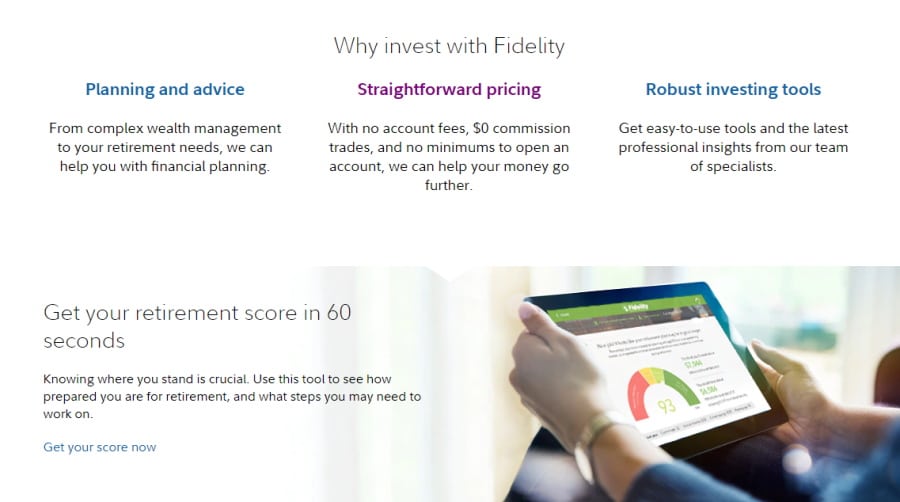
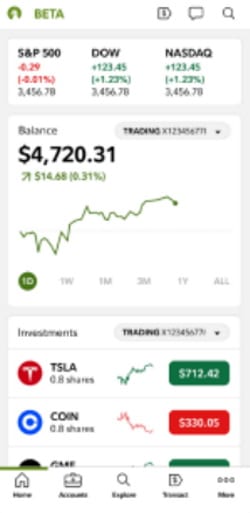
Fidelity offers US ETFs and stock trading on a commission-free basis. Additionally, it provides a wide range of advanced research tools, such as Active Trader Pro, technical analysis, charting, trading ideas, and technical indicators. Whatever your trading objectives and needs are, Fidelity offers an array of account types from standard trading to Roth IRA accounts.
The web trading platform is user-friendly and features a well-designed, interactive, and intuitive interface. Moreover, the account opening process is fully digital which makes for a streamlined trading experience.
When it comes to tradable assets Fidelity provides access to mutual funds, commission-free US stocks and ETFs, fixed income, Bonds and CDs, and options. Furthermore, you can adopt passive trading strategies with Fidelity’s robo investing and wealth management services.
Fidelity Pros & Cons
 What we like
- Straightforward pricing structure with no account fees, 0% commission trades
- No account minimums to open a trading account
- Extensive market research from 20+ providers
- Zero expense ratio index funds
- Customer service representatives available 24/7
- Invest in 7,000+ US stocks and ETFs with $0 commission
- Provides fractional share trading
- Active Trader Pro demo account
- Wide range of payment methods including digital wallets and bank transfers
- No deposit or withdrawal fees
What we don’t like
- Does not support forex or cryptocurrency trading
- Lack of CFD derivatives trading
- Not suitable for investors looking to trade with leverage on a speculative basis
- Credit/Debit cards not accepted as payment methods
- Wire transfers in non-USD currencies incur a 3% withdrawal fee
- The account verification process can be slow
Your capital is at risk.
What Can You Trade on Fidelity?
Stock and ETF Trades
At Fidelity, you can take advantage of in-depth market research and low commission charges to invest in shares of major stock listed on top US and international exchanges.
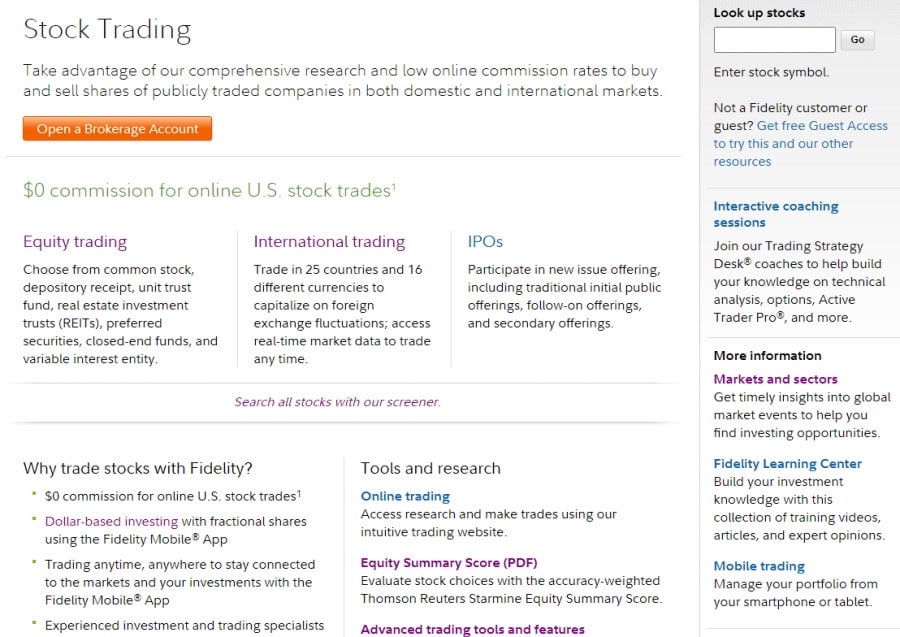
- Equity trading – browse through common stocks, depository receipts, real estate investment trusts (REITs), closed-end funds, unit trust funds.
- International stock trading – access to 25 markets and 16 base currencies to take advantage of price movements in the forex markets, as well as use real-time market analysis to trade around the clock.
- Participate in initial public offerings (IPOs)
What is a stock screener?
A stock screener is a selection of tools that enable traders to filter through heaps of accessible stocks and ETFs based on their own preferences and trading goals.
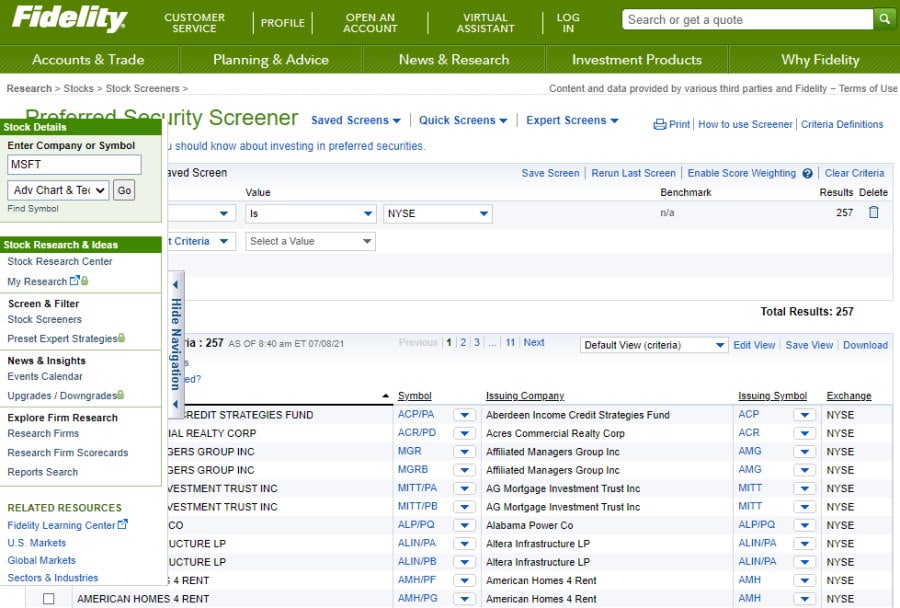
Fidelity provides a useful screener tool that allows you to sort through the thousands of available stocks with the click of a button.
What are some of the benefits of trading stocks with Fidelity?
Aside from the most prominent advantage of commission-free trading, at Fidelity, you can also invest in shares with as little as $1 with fractional share trading. This means you can access more than 7,000 US stocks and ETFs including Apple, Amazon, Tesla, iShares S&P 500 ETF, Fidelity Info Tech ETF, Fidelity Nasdaq Composite Index, Fidelity MSCI Health Care ETF.
Commission-free Fidelity and iShares ETFs
Exchange-traded funds, more commonly referred to as ETFs, come with a basket of benefits when compared to traditional open-end funds. Stock ETFs give you diversified exposure to US and international exchanges, as well as trading flexibility, risk management, lower trading costs, and tax benefits.
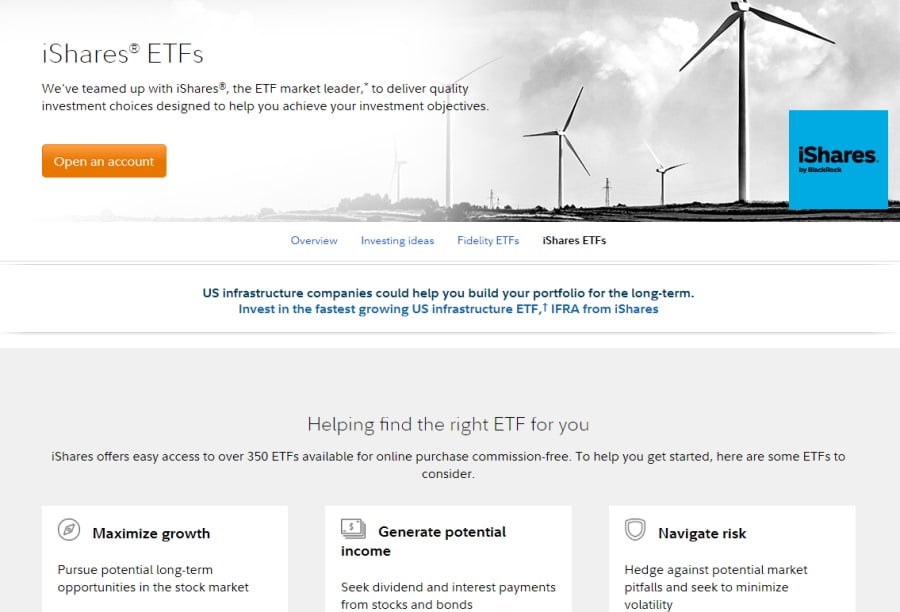
At Fidelity, you can access a myriad of ETFs such as:
- Fidelity® MSCI Real Estate ETF
- Fidelity® Low Volatility Factor ETF
- Fidelity® Value Factor ETF
- Fidelity® Quality Factor ETF
- Fidelity® International High Dividend ETF
- Fidelity® International Value Factor ETF
- iShares Core S&P 500 ETF
- iShares Core MSCI Total International Stock ETF
- iShares Core US Aggregate Bond ETF
As you can see from the list, Fidelity has partnered with BlackRock which means that iShares provides direct access to more than 350 ETFs for online purchase without having to worry about paying a penny in commission charges.
Mutual Funds
Mutual funds are a cost-efficient, feasible way to create a diversified investment portfolio of bonds, stocks, and short-term investments. At Fidelity, you can invest through the FundsNetwork and access more than 10,000 mutual funds from a wide variety of fund companies. You can also access a range of extensive offerings with zero transaction fees.
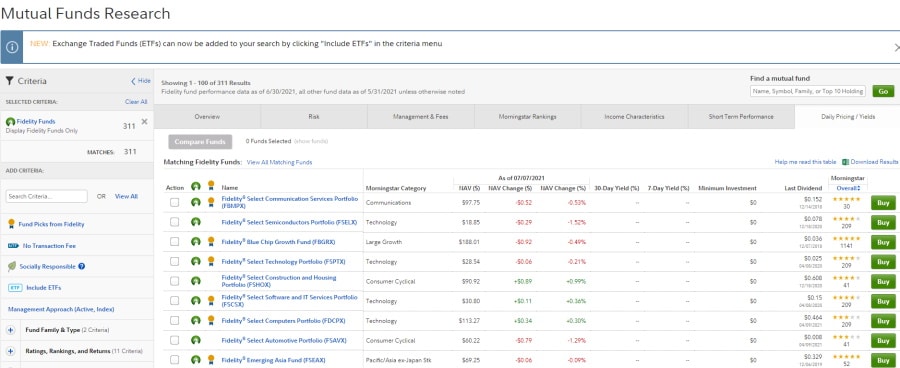
Browsing through 10,000 funds from a pool of fund companies may seem like a daunting task, especially for beginner traders, but with Fidelity’s market-leading tools you can find the right funds to suit your trading style.
Finding the right mutual funds can be done by:
- Fund Picks from Fidelity – professional traders select the top mutual funds in each investment category
- NTF (No Transaction Fee) funds – a large number of funds are accessible with no transaction fees.
- Browsing through Morningstar’s top-rated mutual funds
- Using the Evaluator tool you can filter your searches by fund groups and categories
The types of mutual funds supported by Fidelity include US equity funds, sector funds, international equity funds, asset allocation funds, municipal bond funds, taxable bond funds, and index funds.
Options trading
An option, commonly referred to as a stock or equity option, is a contract between the buyer and seller relating to an underlying asset. The option’s buyer gains the right to make the seller do whatever the contract instructs before the expiration date. After the buyer has exercised the option, the seller is required to do whatever the contract specifies.
For instance, a put option on a US stock gives the buyer the right to sell a set number of shares at a preset cost within the timeframe set by the option itself. The seller is required to buy the stock from the buyer if the option is exercised.

Whether you are an experienced investor or new to options trading, Fidelity provides a wide range of research and trading idea tools, as well as educational resources to help optimize your options trading.
When it comes to the trading costs, these are transparent and straightforward, at $0.65 per options contract and no commissions, Fidelity offers a cost-effective way to trade options without busting the bank.
Moreover, with the Fidelity Rewards+, eligible Wealth Management traders can benefit from $0 contract fees when trading options up to 100,000 over a one-year period.
Fidelity’s Fees & Commissions
Arguably the best selling point is Fidelity’s offering of commission-free US stock, ETF, and options trading. This has become common practice amongst the best online trading platforms, including the likes of eToro and Robinhood.
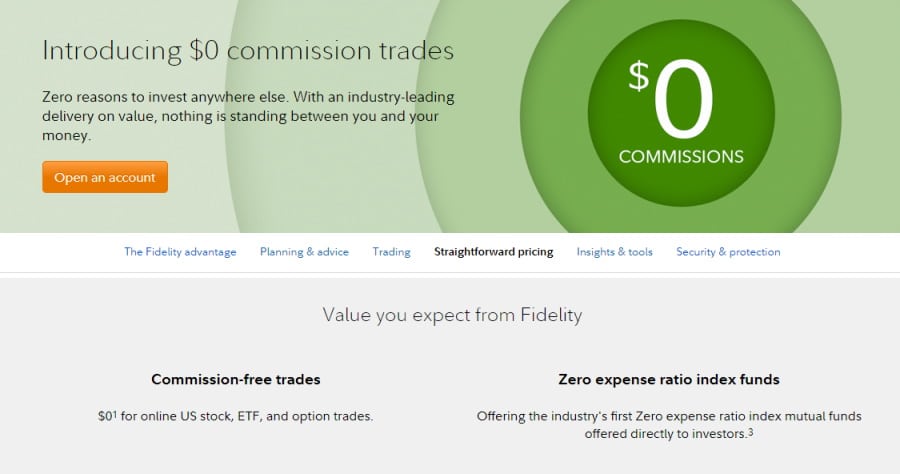
For a more detailed look at Fidelity’s trading fees check out the table below.
| Tradable Asset | Commission |
| Stocks – all online US equity trades | $0 |
| Options | $0 commission + $0.65 per contract |
| ETFs | $0 |
| Bonds and CDs | New Issues $0 |
| Mutual Funds (Fidelity Funds) | $0 |
| No Transaction Fee (NTF) non-Fidelity funds | $0 on purchase. $49.95 on redemption if held less than 60 days |
| Transaction Fee non-Fidelity funds: | $49.95 per purchase, $0 on redemption |
Non-trading fees
| Non-trading fee | Charge |
| Account service fee | $0 |
| Account transfer out | $0 |
| Minimum initial investment | $0 |
| Bank wire | $0 |
| IRA closeout fee | $0 |
| Stop payment | $0 |
From this data, we concluded that Fidelity’s trading fees are low and traders will appreciate the transparent fee model. Fidelity does not charge commission for US ETF and stock trades. When it comes to trading shares of stock listed on non-US markets, Fidelity charges a fixed commission that varies depending on the exchange. For example, buying shares of stocks listed on the London Stock Exchange will lead to a commission of £9 per online trade, and £30 if the trade is placed with the help of a Fidelity representative.
Margin fees
Before we have a look at Fidelity’s margin fees, let’s address the question of what is margin trading? With a margin account, you can borrow capital from the broker based on the amount you have deposited. Simply put, this means that you can open positions with funds borrowed from your chosen brokerage firm.
Fidelity’s current base margin rate is 7.075%.
| Debit balance | Margin rate | Effective rate |
| $1M+ | Base – 3.075% | 4.000% |
| $500,000-$999,999 | Base – 2.825% | 4.250% |
| $250,000-$499,999 | Base – 0.500% | 6.575% |
| $100,000-$249,999 | Base – 0.250% | 6.825% |
| $50,000-$99,999 | Base – 0.200% | 6.875% |
| $25,000-$49,999 | Base + 0.750% | 7.825% |
| $0-$24,999 | Base + 1.250% | 8.325% |
Fidelity User Experience
If you’re new to online trading and have an interest in gaining exposure to US and international markets but are hesitant because of a lack of trading experience, Fidelity is an ideal place to start. Fidelity offers a user-friendly web trading platform, mobile trading app, and the Active Trader Pro desktop platform.
For example, opening an account is fully digital and simple, and with no account minimums, you can start trading fractional shares with as little as $1. Furthermore, with the stock screener and stock research tools, you can navigate your way through thousands of stocks to find the ones that are best suited to your trading goals. Alternatively, you can use the search bar at the top of the fidelity.com website and enter the ticker symbol for your preferred assets.
Moreover, by clicking on the News & Research tab on the main menu you can access a range of features from daily news updates and webinars, to a comprehensive Learning Center designed to help beginner traders and experienced investors develop and improve their investment strategies.
Fidelity Features, Charting, and Analysis
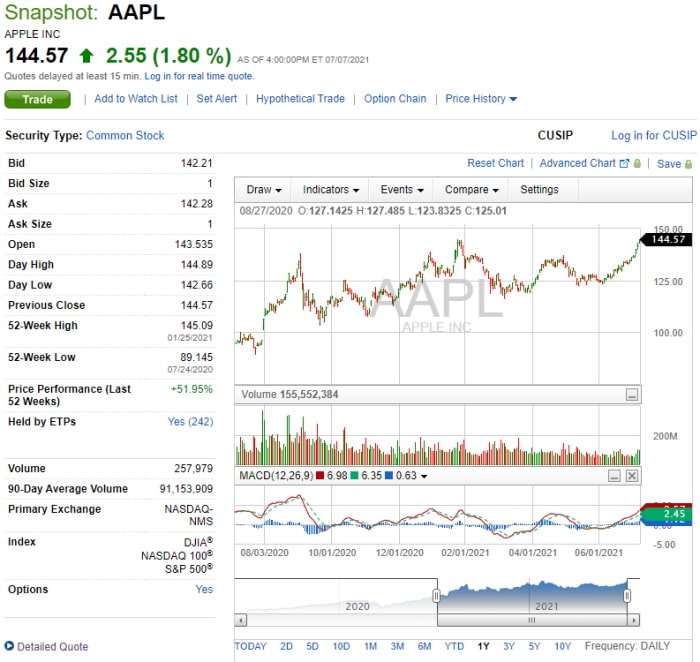
The charting experience on Fidelity is pretty basic with all the standard features. You can integrate technical indicators including Bollinger Bands, EMA, MACD, Parabolic SAR, and many more with the click of a button. You can also access drawing tools such as trendlines and notes, as well as having the option to compare up to 10 different assets on the same chart.
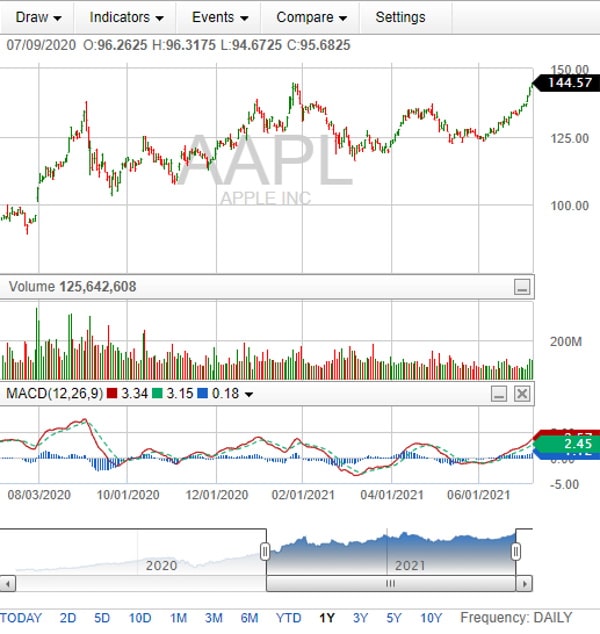
Underneath the charts, you can find a huge selection of useful data from news and events to analyst opinions and research reports.
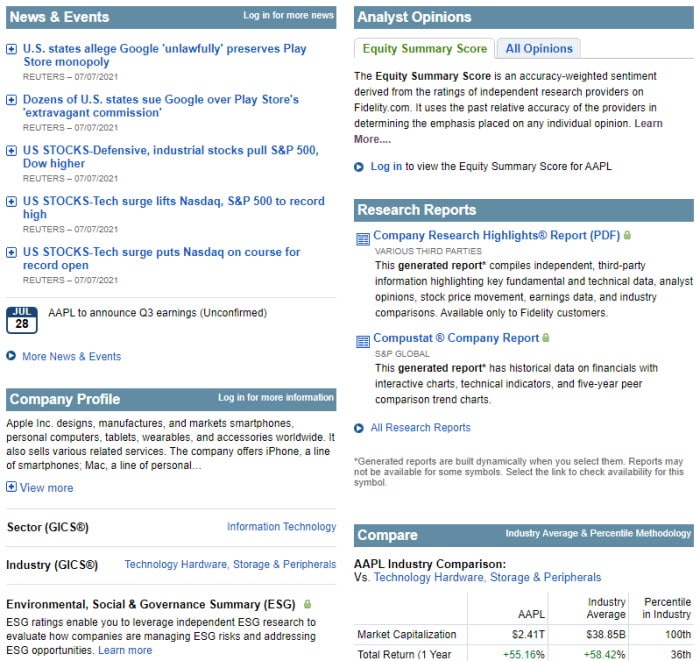
Fidelity provides thorough fundamental data, that allows you to research and find key information for all supported assets, such as stocks and ETFs. For example, for Apple Inc you can find key statistics such as the market cap, P/E 5-year average, enterprise value, and more.
Fidelity Account Types
While there are no minimum deposits for basic trading accounts, there are minimum deposits for margin accounts, day trading accounts, and Fidelity Managed Accounts. These are as follows:
- Basic trading accounts – $0
- Margin accounts – $2,000
- Day trading accounts – $25,000
- Fidelity Managed Accounts – $10 – $500,000
Fidelity offers a huge variety of account types which we have broken down into this convenient table below:
| Category | Account types |
| Investing and Trading | Brokerage Account – The Fidelity Account, Cash Management Account – Fidelity Cash Management Account, Brokerage and Cash Management, The Fidelity Account for Businesses. |
| Retirement accounts | Rollover IRA, Traditional IRA, Roth IRA, Inherited Roth IRA, SEP IRA, Self-Employed 401(k), SIMPLE IRA, Investment-Only plans for small business, 401(k) plan for small businesses. |
| Managed accounts – robo advisors | Fidelity Go, Fidelity Personalized Planning & Advice, Portfolio Advisory Services Accounts, Fidelity Tax-Managed U.S. Equity Index Strategy, Fidelity Equity-Income Strategy, International Equity Strategy, Tax-Managed International Equity Index Strategy, U.S. Large Cap Equity Strategy, Core Bond Strategy, Intermediate Municipal Strategy, Breckinridge Intermediate Municipal Strategy. |
| Saving & investing for a child | 529 Account, Fidelity Youth Account, Custodial Account, Roth IRA for Kids, The Attainable Savings Plan. |
| Saving for medical expenses | Health Savings Account (HSA) |
| Charitable giving | Fidelity Charitable |
| Estate planning and trusts | Trust account, Estate |
| Annuities | Personal Retirement Annuity, Deferred Fixed Annuities, Immediate Fixed Income Annuities, Deferred Income Annuities. |
| Life Insurance | Universal Life, Term Life Insurance |
The account opening process is streamlined and is usually fully digital. Depending on your country of residence the account opening and verification process can take up to 3 business days, which is slower than other online brokers, such as eToro.
Fidelity Mobile App Review
The Fidelity mobile trading app allows you to monitor and manage your investment portfolios and watch lists wherever you are 24/7. The trading app is compatible with a wide range of devices including:
- iOS iPhones and iPads
- Android mobile devices
- Apple Watch
- Kindle Fire
With key financial features like real-time quotes, news, price alerts, and advanced charting, you can stay in the market loop without being stuck to your desktop monitor.
You can even access dollar-based investing with fractional shares of major US stocks with as little as $1. This not only allows you to improve your portfolio diversification on a low budget, but you can do it anytime and anywhere from your mobile smartphone.
Furthermore, you can deposit funds, execute trades, track your open positions, and receive real-time push notifications.
If you are an Apple enthusiast you will be pleased to know that you can use Touch and Face ID, otherwise known as biometric authentication, to swiftly and conveniently log into your trading account without having to remember passwords.

Active traders will greatly appreciate the option to set up price alerts and push notifications. As such, you can take advantage of unique trading opportunities with real-time alerts on your mobile device.
As the digital era continues to evolve, the financial sector is also finding innovative and convenient ways to make online trading more accessible and streamlined as possible. Fidelity’s mobile trading app provides users with both the flexibility and convenience to trade anywhere and at any time.
Fidelity Payments
You can deposit and withdraw funds into and out of your Fidelity trading accounts via a range of e-payment methods and bank transfers. Payment apps such as PayPal, Venmo, Apple Pay, Google Pay, and Square Cash, are a user-friendly, and secure way to transfer capital into your Fidelity account, usually done instantly with a couple of taps.
Fidelity also offers a free online service called Bill Pay that allows you to pay for goods and services and manage your bills with your trading account or Cash Management account. This service comes with the added benefit of being able to schedule and make payments wherever you are.
It is also important to note that there are no deposit or withdrawal fees when you transfer money in and out of your Fidelity brokerage account.
What about Fidelity’s Subsidiary – UK-based Fidelity International?
Launched in 1969, Fidelity International is the subsidiary of Fidelity Investments and is regulated by the UK’s Financial Conduct Authority. This UK-based stockbroker is ideal for new traders and long-term investors interested in gaining exposure to the UK market. As such, you can only buy and sell stocks and ETFs that are listed on the LSE. There is, however, an extensive selection of mutual funds available from 150+ third-party providers such as BlackRock and Vanguard.
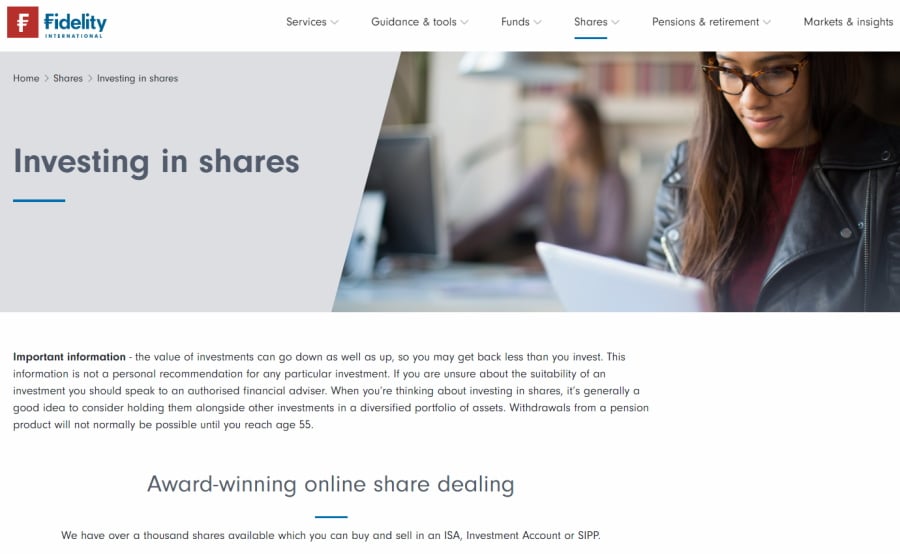
While the non-trading fees are low, Fidelity International charges a fixed commission when trading stocks and ETFs. Furthermore, the minimum deposit is £1,000 when opening an account which is rather high when compared to other free trading platforms out there, such as eToro, that offer commission-free stock trading as well as low minimum deposits.
Fidelity Contact and Customer Service
Fidelity’s customer support is amongst the best in the industry, with several options available 24 hours a day 7 days a week, you can contact a customer service representative at any time whenever you need.
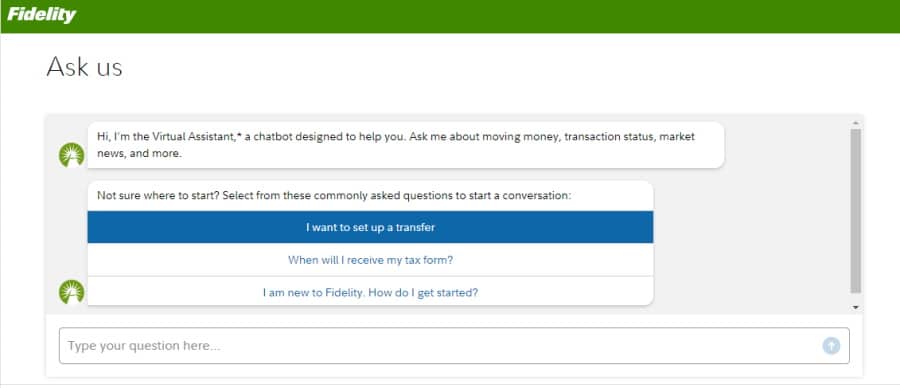
You can contact customer support via:
- Virtual assistant (chatbot)
- Telephone (800-343-3548)
- Mailing address – if you need to mail a form or other documents for verification purposes, US-based clients can find the right US mailing address that suits them.
- Multiple Fidelity Investor Centers that offer in-person consultations as well as virtual and phone appointments.
According to the Fidelity.com website, the call volumes are currently very high, meaning waiting times may be longer during exceptionally busy times. Alternatively, there is a useful FAQs page that can help with basic inquiries and troubleshooting.
Fidelity Review Reddit – See What Other Users Have to Say
The Fidelity Reddit group, r/fidelityinvestments, is home to 16.3k members and is a great social platform to gain support and answers to your questions. As an official Fidelity customer support channel, Fidelity’s Reddit community offers customer services directly from the broker’s associates.
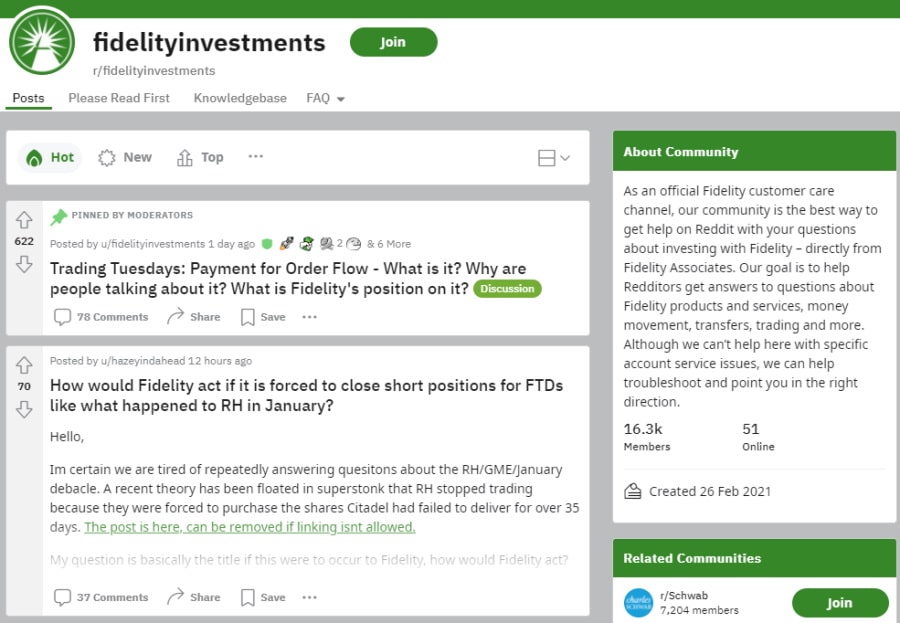
The aim is to help Redditors find relevant answers to queries about investment products and services and more.
Is Fidelity Safe?
Fidelity is regulated by the US Securities and Exchange Commission and is a member of the Financial Industry Regulatory Authority (FINRA).
Fidelity offers a Customer Protection Guarantee, which means that you will be reimbursed for losses from unauthorized activity in your trading accounts. Moreover, Fidelity also participates in asset protection programs like the FDIC and SIPC which protect against the loss of cash and securities if the broker goes into insolvency. The limit of the SIPC protection is $500,000.
The web trading platform also supports two-factor authentication (2FA) and the mobile trading app offers biometric authentication for added security and convenience when logging in and out of your Fidelity brokerage account.
How to Start Trading with Fidelity
In this section of our Fidelity Investments review, we will guide you through the process of getting started with Fidelity.
Step 1: Join Fidelity
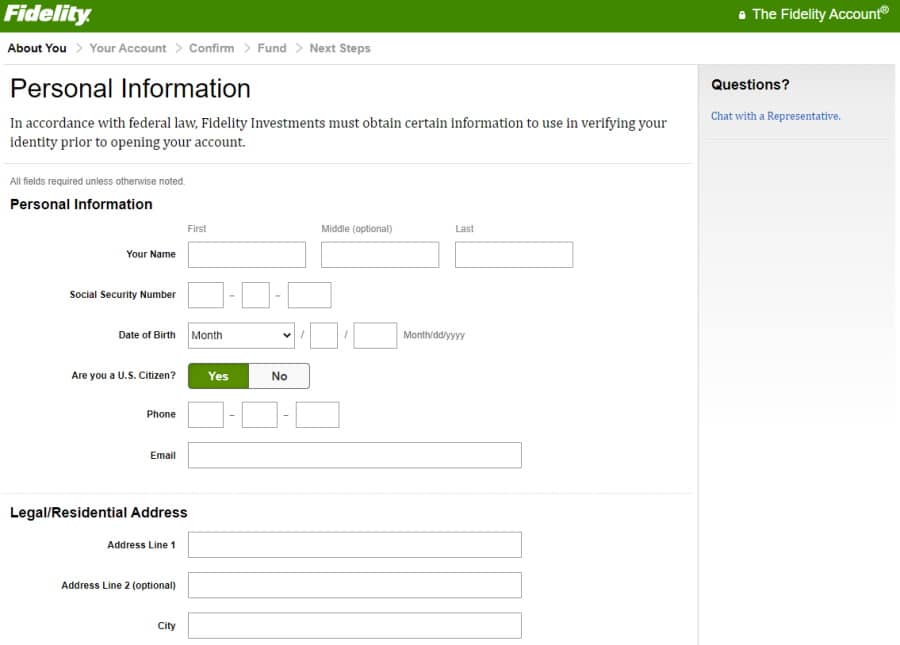
First of all, you will need to open an account with Fidelity. To do this simply click on the Open Account link at the top of the screen, then choose the account type you want and enter your details such as name, email address, date of birth, social security number, and address.
Step 2: Verify your account and deposit funds
To verify your account you will need to upload copies of your passport and address as proof of identity and residency. Once your account has been verified you can go ahead and deposit funds into your account via any of the supported payment methods.
Step 3: Start trading
To trade with Fidelity start by selecting the account you want to trade in. Then search for the asset and choose either Buy or Sell. Choose either USD or Shares and enter the amount you wish to trade.
Fidelity vs eToro
Before opening an account with Fidelity, we would recommend considering eToro. After extensive research and reviewing heaps of the best online brokers, eToro secures the top spot on our list for the following reasons:
67% of retail investor accounts lose money when trading CFDs with this provider.
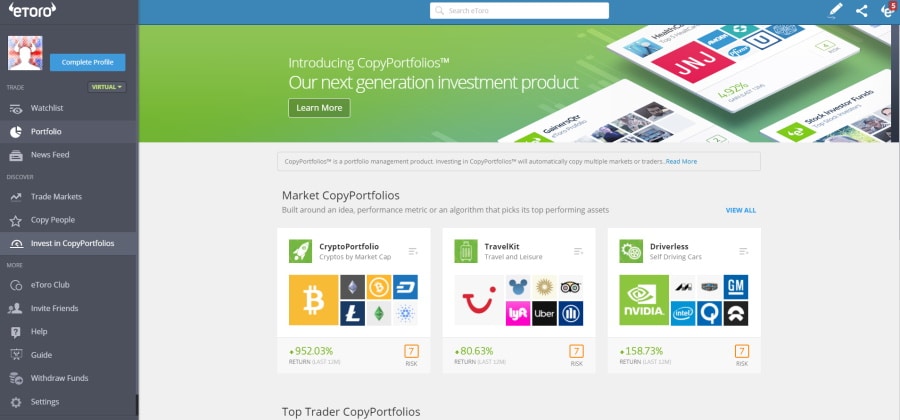
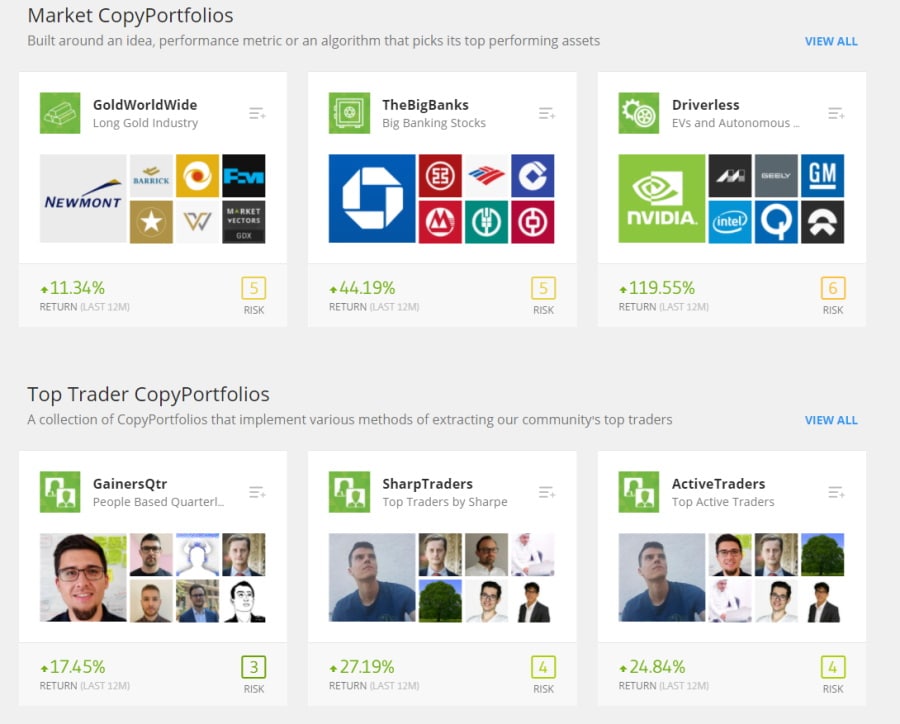
- Copy trading and social trading – eToro facilitates passive investing via its CopyTrader and CopyPortfolio tools. eToro allows you to browse through the public profiles of experienced traders and pick your favourites to copy their trading strategies for an effortless automated trading experience. Alternatively, you can invest in specific themes such as crypto portfolios or a combination of eToro traders via a single investment portfolio. You can pick traders based on fundamental data such as past performance and risk ratings. In terms of social trading, you can interact and communicate with the rest of the trading community on the free trading platform with the click of a button.
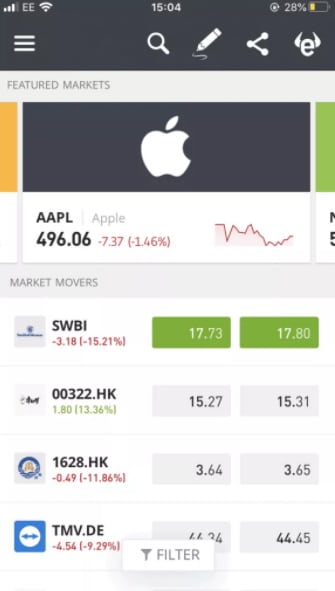
- Fractional share trading – fractional shares have become a key element of the modern stock trading scene. At eToro, the minimum investment is $50 which means that you can invest in popular stocks such as Apple and Amazon with an investment that suits your account balance and budget. Fractional share trading helps to improve your portfolio diversification with relatively low costs.
- Fully regulated broker – eToro is regulated by the UK’s FCA, CySEC, and ASIC.
- Cryptocurrency Trading – At eToro you can trade and store 19 different cryptos including Bitcoin and Ethereum. eToro also conveniently provides its proprietary secure crypto wallet for you to store your crypto coins in one place.
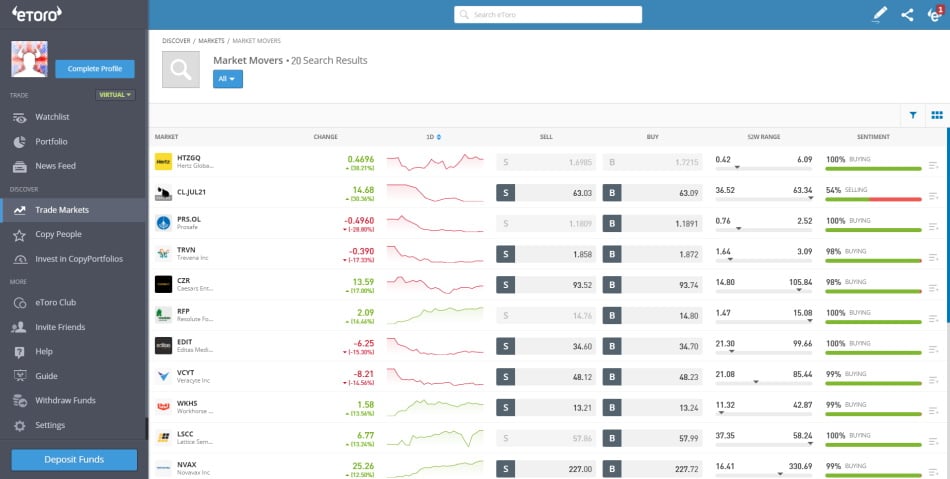
- You can access 17 stock exchanges, and trade stocks and ETFs without paying a penny in commissions.
- Wide range of CFD derivatives including forex, commodities, indices, stock CFDs and ETF CFDs, and Crypto CFDs. As there are no trading commissions eToro charges market-leading spreads on forex pairs as low as 1 pip, and stock CFDs from 0.09%.
Fidelity Review – The Verdict
If you’re a beginner looking to trade financial assets, such as commission-free US stocks and ETFs, then Fidelity is likely a great option. The broker provides heaps of stocks, ETFs, mutual funds, and options trades, as well as heaps of educational resources and technical tools.
However, we found that eToro allows you to gain exposure to stocks, ETFs, forex, cryptos, and more on a commission-free basis. Furthermore, with CFD trading you can speculate on the price movements without taking ownership of the underlying asset.
So, to start copy trading with a top-rated and regulated broker, simply follow the link below and open an eToro account today!
eToro – Best Copy Trading Platform for Commission-free Stock Trading
67% of retail investor accounts lose money when trading CFDs with this provider.