Letter of Credit: What It Is, Examples, and How One Is Used
Julia Kagan is a financial/consumer journalist and former senior editor, personal finance, of Investopedia.
What Is a Letter of Credit?
A letter of credit, or a credit letter, is a letter from a bank guaranteeing that a buyer’s payment to a seller will be received on time and for the correct amount. If the buyer is unable to make a payment on the purchase, the bank will be required to cover the full or remaining amount of the purchase. It may be offered as a facility (financial assistance that is essentially a loan).
Due to the nature of international dealings, including factors such as distance, differing laws in each country, and difficulty in knowing each party personally, the use of letters of credit has become a very important aspect of international trade.
Key Takeaways
- A letter of credit is a document sent from a bank or financial institute that guarantees that a seller will receive a buyer’s payment on time and for the full amount.
- Letters of credit are often used within the international trade industry.
- There are many different letters of credit including one called a revolving letter of credit.
- Banks collect a fee for issuing a letter of credit.
Jessica Olah / Investopedia
How a Letter of Credit Works
Buyers of major purchases may need a letter of credit to assure the seller that the payment will be made. A bank issues a letter of credit to guarantee the payment to the seller, essentially taking responsibility that the seller will be paid. A buyer must prove to the bank that they have enough assets or a sufficient line of credit to pay before the bank will guarantee the payment to the seller.
Banks typically require a pledge of securities or cash as collateral for issuing a letter of credit.
Because a letter of credit is typically a negotiable instrument, the issuing bank pays the beneficiary or any bank nominated by the beneficiary. If a letter of credit is transferable, the beneficiary may assign another entity, such as a corporate parent or a third party, the right to draw.
The International Chamber of Commerce’s Uniform Customs and Practice for Documentary Credits oversees letters of credit used in international transactions.
How Much a Letter of Credit Costs
Banks will usually charge a fee for a letter of credit, which can be a percentage of the total credit that they are backing. The cost of a letter of credit will vary by bank and the size of the letter of credit. For example, the bank may charge 0.75% of the amount that it's guaranteeing.
Fees can also depend on the type of letter. In an import-export situation, an unconfirmed letter of credit is less costly. A confirmed letter of credit may have higher fees attached based on the issuing bank's credit strength.
Types of Letters of Credit
The types of letters of credit include a commercial letter of credit, a revolving letter of credit, a traveler’s letter of credit, and a confirmed letter of credit. International trade will also sometimes use an unsecured—red clause—letter of credit.
Commercial Letter of Credit
This is a direct payment method in which the issuing bank makes the payments to the beneficiary. In contrast, a standby letter of credit is a secondary payment method in which the bank pays the beneficiary only when the holder cannot.
Revolving Letter of Credit
This kind of letter allows a customer to make any number of draws within a certain limit during a specific time period. It can be useful if there are frequent shipments of merchandise, for example, and you don't want to redraft or edit letters of credit each time.
Traveler’s Letter of Credit
For those going abroad, this letter will guarantee that issuing banks will honor drafts made at certain foreign banks.
Confirmed Letter of Credit
A confirmed letter of credit involves a bank other than the issuing bank guaranteeing the letter of credit. The second bank is the confirming bank, typically the seller’s bank. The confirming bank ensures payment under the letter of credit if the holder and the issuing bank default. The issuing bank in international transactions typically requests this arrangement.
Example of a Letter of Credit
Citibank offers letters of credit for buyers in Latin America, Africa, Eastern Europe, Asia, and the Middle East who may have difficulty obtaining international credit on their own. Citibank’s letters of credit help exporters minimize the importer’s country risk and the issuing bank’s commercial credit risk.
Letters of credit are typically provided within two business days, guaranteeing payment by the confirming Citibank branch. This benefit is especially valuable when a client is located in a potentially unstable economic environment.
How to Apply for a Letter of Credit
Letters of Credit are best prepared by trained professionals, as mistakes in the detailed documents required can lead to payment delays and fees. Due to industry variations and types of letters of credit, each may be approached differently.
Here's an import-export example.
- The importer’s bank credit must satisfy the exporter and their bank. The exporter and importer complete a sales agreement.
- Using the sales agreement's terms and conditions, the importer’s bank drafts the letter of credit; this letter is sent to the exporter's bank. The exporter’s bank reviews the letter of credit and sends it to the exporter after approval.
- The exporter ships the goods as the letter of credit describes. Any required documentation is submitted to the exporter's bank.
- The exporter’s bank reviews documentation to ensure letter of credit terms and conditions were met. If approved, the exporter's bank submits documents to the Importer’s bank.
- The importer's bank sends payment to the exporter’s bank. The importer can now claim the goods sent.
Advantages and Disadvantages of a Letter of Credit
Obtaining letters of credit may be necessary in certain situations. However, like anything else related to banking, trade, and business there are some pros and cons to acknowledge.
Advantages and Disadvantages of a Letter of Credit
Can create security and build mutual trust for buyers and sellers in trade transactions.
Makes it easier to define the specifics of when and how transactions are to be completed between involved parties.
Letters of credit can be personalized with terms that are tailored to the circumstances of each transaction.
Can make the transfer of funds more efficient and streamlined.
Buyers typically bear the costs of obtaining a letter of credit.
Letters of credit may not cover every detail of the transaction, potentially leaving room for error.
Establishing a letter of credit may be tedious or time-consuming for all parties involved.
The terms of a letter of credit may not account for unexpected changes in the political or economic landscape.
How Does a Letter of Credit Work?
Often in international trade, a letter of credit is used to signify that a payment will be made to the seller on time, and in full, as guaranteed by a bank or financial institution. After sending a letter of credit, the bank will charge a fee, typically a percentage of the letter of credit, in addition to requiring collateral from the buyer. Among the various forms of letters of credit are a revolving letter of credit, a commercial letter of credit, and a confirmed letter of credit.
What Is an Example of a Letter of Credit?
Consider an exporter in an unstable economic climate, where credit may be more difficult to obtain. A bank could offer a buyer a letter of credit, available within two business days, in which the purchase would be guaranteed by the bank's branch. Because the bank and the exporter have an existing relationship, the bank is knowledgeable of the buyer’s creditworthiness, assets, and financial status.
What Is the Difference Between a Commercial Letter of Credit and a Revolving Letter of Credit?
As one of the most common forms of letters of credit, commercial letters of credit are when the bank makes payment directly to the beneficiary or seller. Revolving letters of credit, by contrast, can be used for multiple payments within a specific time frame. Typically, these are used for businesses that have an ongoing relationship, with the time limit of the arrangement usually spanning one year.
The Bottom Line
Letters of credit can play an important part in trade transactions. There are different types of letters of credit that may be used, depending on the circumstances. If you need to obtain a letter of credit for a business transaction, your current bank may be the best place to begin your search. You may, however, need to expand the net wider to include larger banks if you maintain accounts at a smaller financial institution.
Letter of Credit – Working, Process to Apply, Types and Examples
A letter of credit or credit letter is a bank-issued document that guarantees a seller will receive full payment from a buyer on time. Financial institutions also issue this document in exchange for security or cash. Usually, banks collect a fee that is a percentage of the amount of the credit letter. It is an essential document while trading internationally. International trade involves aspects like distance, different laws of both countries lack of face-to-face contact, and much more. To smooth out this complicated process, a bank issues a credit letter.
This blog decodes all the questions about the Letter of Credit and its functions. Read to know more!
How Does a Letter of Credit Work?
The process of a Letter of Credit is not as tedious as it seems:
-
Issuing the Letter of Credit
A LOC is issued by the importers bank. The importer applies to the issuing bank to issue a LOC in favor of the exporter after the parties to the trade agreement on the contract and the use of LOC. The issuing bank transmits the LOC to the advising bank. The latter is usually located in the country of the exporter and may even be the exporter’s bank. The advising bank (confirming bank) validates the LOC and sends it to the exporter.
After receiving the LOC, the exporter is required to verify the documents to ensure their authenticity and begin the goods shipment process.
Following the shipment of the goods, the exporter ( directly or through freight forwarders) submits the documents to the advising/confirming bank.
In turn, the bank sends the documents to the issuing bank, where the amount is paid, accepted, or negotiated, depending on the circumstances. The issuing bank approves and verifies the documents and collects payment from the importer. Then it forwards the documents to the importer, who then uses them to take possession of the shipped goods.
Example of Letter of Credit
For example, Mr. E (an Indian exporter) has a shipment of goods contract with Mr. F (a US importer). Both parties, who are strangers to each other, agree to a LOC arrangement. Mr. E is assured that he will be paid by the buyer, and Mr. F is assured that he will have a systematic and documented process in place, as well as evidence that goods have been shipped.
This is how a Letter of Credit will work between the two parties:
- Mr. F (buyer) requests the issuing bank to issue a letter of credit on his behalf
- The issuing bank then processes the LOC to the advising bank (Mr. E’s Bank)
- The advisory bank verifies the LOC’s legitimacy before sending it to Mr. E
- Now that Mr. E receives the confirmation, he will ship the items and, together with other required paperwork, will get a Bill of Lading. He then sends the documents to the negotiating bank.
- The negotiating bank will ensure that all conditions are met and will then pay Mr. E as a result (the seller).
- The negotiating bank will also transmit the required paperwork to the issuing bank.
- Again, Mr. F (the buyer) will receive a copy of this from the issuing bank to validate its legitimacy.
- Mr. F will pay the issuing bank after receiving confirmation.
- Furthermore, the issuing bank will transfer the funds to the negotiating bank.
Also Read


What are the Different Types of Letters of Credit?
There are mainly four types of letters of credit:
1. Revocable
The terms and conditions of a letter of credit that is revocable can be changed or revoked by the bank that issued it. Beneficiaries do not need to be informed of any changes to the letter of credit by the issuing bank.
2. Irrevocable
The issuing bank cannot change or cancel the terms and conditions of an irrevocable credit. The bank is required to follow the instructions or commitments stated in the letter of credit.
3. A Standby Letter of Credit
An importer can get foreign currency funds abroad through the Standby Letter of Credit (SBLC), a credit mechanism in which the domestic bank issues an SBLC that ensures payment to the foreign bank in the event that the borrower fails to make the required repayments by the due date.
4. Credit on Sight
In this type of credit, an entrepreneur can present a bill of exchange with a sight letter to the lender and receive funds immediately on the basis of the sight letter. A sight letter of credit is the quickest letter of credit that can be obtained.
5. Transferable
As the name implies, transferable credit is a type of LC in which the beneficiary can transfer his or her rights to third parties. The terms and conditions may vary depending on the trade and industry.
Benefits of a Letter of Credit
Following are the benefits of a letter of credit:
- It allows a trade partner to trade with unknown partners. Moreover, it helps expand one’s business to new foreign locations.
- A credit letter is like a contract that enables trading partners to back out from the deal in case of disputes. Besides, an exporter can withdraw funds as agreed upon in a credit letter.
- This financial document is highly beneficial to a seller if an importing company goes bankrupt. Since a credit letter transfers an importer’s creditworthiness to the issuing bank, the financial institution has to pay a seller on behalf of the importer.
- Both trading parties, an importer and exporter, can customise a contract based on their requirements. Further, they can change the clauses from one transaction to another.
- The court describes the right to the total amount in the phrase “pay now, litigate later”.
Disadvantages of Letter of Credit
While a credit letter is beneficial for buyers and sellers, there are a few disadvantages too. They are as follows:
- It increases bank charges for this service. Moreover, credit letter charges increase steeply if either party wants to put in some additional features.
- The life cycle of a credit letter has an expiration date. As a result, an exporter has to export all products within a given time period, which could result in a mess.
- It can give way to material fraud risk. A bank will pay a seller based on its shipment documents and not based on a product’s quality. Later, disputes can arise if the quality is different from what was agreed upon initially.
- Using a letter of credit can result in delays and other administrative issues.
- The issuing bank is responsible for the Letter of Credit’s payment reliability.
How is a Letter of Credit Issued?
A letter of credit is issued by following the below steps:
Step 1: The buyer approaches a bank for issuing a credit letter. This chosen financial institution becomes the issuing bank.
Step 2: The beneficiary or seller will also have an advising bank on their team. Usually, these advising banks are international banks that check a document’s authenticity on behalf of the seller.
Step 3: The advising bank will keep the credit letter with them. This will assure the seller that he/she will receive money no matter what, as banks are now involved in the process.
Step 4: The seller will ship products as per terms both the seller and buyer and mutually agreed upon. Furthermore, the seller will receive a bill of lading as the entity has already exported goods.
Step 5: The buyer now has to present a bill of lading to the nominated bank (international bank) that will review all the shipping documents. If the nominated financial institution finds that all regulations are met, it will pay the seller.
Step 6: The nominated bank will send over shipping documents to the issuing bank and ask for the money the bank had spent on paying the seller.
Step 7: Next, the issuing bank will share all the documents with the importer. Moreover, this bank will seek approval from the importer and ask them if all documents are correct as per their knowledge and if all products are shipped or not.
Step 8: Finally, the importer gives money to the issuing bank, which pays the nominated bank.
List of Banks and NBFCs Offering Letter of Credit
Below is the list of banks offering LOC:
- SBI
- Kotak Mahindra Bank
- ICICI Bank
- Punjab and Sind Bank
- IDBI Bank
- HDFC Bank
- Axis Bank
- Union Bank of India
- Lendingkart Finance
- DBS
- Bandhan Bank
Also Read


Documents Required for Letter of Credit
- Fill the application form with passport-sized photographs
- KYC of the applicant, co-applicants, partners, directors
- Bill of Exchange
- Commercial Invoice
- Certificate of Origin
- Health and Insurance certificates – Original
- Buyer’s Financial Documents
- Packing, Shipping, and Transport Documents
- Landing airway bills, cargo receipts, etc.
- Related Commercial documents – Certificate of Inception
- Official Documents required by the buyer’s/seller’s country
- Any other document required by the lender
How Does a Letter of Credit Help Buyers?
Generally, a credit letter is known to help a seller during international trade and exchange. This is because a bank will ensure that the seller receives money from the buyer or an issuing bank. However, this monetary document is also beneficial for the buyer when the buyer has already made the payment, and the seller has delayed the shipment. In a situation like this, the buyer will get paid back the money that he or she had spent on making the credit letter.
A seller will have to pay a penalty when the importer receives the refund. Additionally, with the help of a refund, a buyer can now purchase the same products from another party.
How Does a Bank Get Money for a Letter of Credit?
A bank enters into a contract with a buyer and a seller in the event of a credit letter. In accordance with this agreement, if the exporter is unable to complete the payment on time, the bank is required to make a payment to the seller on behalf of the buyer. Also, a bank that gives a credit letter will only do so if it is confident that the buyer will be able to pay the seller. A buyer must therefore pay the bank directly. Nonetheless, both the buyer and the seller must sign a confirmation letter if the seller is unsure that an issuing bank will no longer be able to make payments in the future. In this case, another bank will guarantee for the issuing bank.
Final Word
A letter of credit helps in minimising all risk factors during international trade and exchange. Moreover, it helps one manage cash flow as an importer does not need to make payments during the initial stages of a deal. Hence, this financial document is beneficial for both importers and exporters.
Ready to take the next step towards your financial goals? Apply for Navi Cash Loan in a 100% paperless manner at affordable rates and get the funds you need to achieve your dreams!
FAQs
Yes, a bank will charge a fee while issuing a credit letter. Typically, most banks charge half per cent of the actual amount that a buyer needs to pay to a seller. Moreover, fees depend on multiple factors like risk amount, etc.
A bank guarantee is a promise that it will step up if a debtor cannot pay their debts. On the other hand, a credit letter is a financial document that promises that it will pay on behalf of a buyer to a seller if the former fails to make payment.
The duration of getting a credit letter from a bank depends on the issuing bank. Usually, the approval process takes around 10-15 days. However, the time might increase depending on various factors. Moreover, a bank’s relationship with its client is also a huge factor in getting a credit letter as soon as possible.
An issuing bank can ask its client for collateral if they have doubts about that client’s finances. One can keep fixed deposits as collateral. That said, the final decision will be of the banks, whether they want to enter into the transaction or not.
Citibank is well known for offering credit letters to buyers from Africa, Asia, Eastern Europe, Latin America and the Middle East. This is for buyers who have faced problems while obtaining international credit on their own. It helps minimise the importer country’s risk, and it also reduces issuing bank’s commercial credit risk.
Like the guarantee, the Standby Letter of Credit (Standby LC) is frequently used to offset the risk of a contract party failing to uphold agreed-upon responsibilities, including failing to pay or deliver.
A letter of credit is simply a contract between a beneficiary, a bank, and the bank’s client. The letter of credit, which is often issued by an importer’s bank, assures the beneficiary that payment will be made once the terms of the letter of credit have been satisfied.
A revocable letter of credit is one that the issuing bank may cancel or change at any time without notifying the beneficiary or getting their permission.
Letter of Credit
A Letter of Credit (LC) can be thought of as a guarantee that is backstopped by the Financial Institution that issues it. One party is required to guarantee something to another party; typically, it’s payment, but not always – it could also be guaranteeing that some project will be completed.
Because counterparties in many transactions are (relatively) unknown to one another, it’s common for one party to demonstrate its creditworthiness by tapping into its primary banking relationship and asking that bank to issue an LC on its behalf.
That counterparty can then get comfortable with a transaction knowing that the buyer’s bank has issued a guarantee. In exchange for a fee, the buyer is effectively substituting its own creditworthiness (which is hard for the seller to measure) with that of a large and reputable financial institution.
Letters of Credit are especially common for cross-border transactions where trust and timing issues are exacerbated by other factors like political and shipping risk, as well as limitations around security registration.
Summary
- A Letter of Credit is a form of guarantee issued by a bank on behalf of its client.
- An LC is used when trust between counterparties is hard to quantify.
- The instrument is especially common in global trade among partners in different countries.
Types of Letters of Credit
Letters of Credit fall into one of two categories. They are either financial in nature or documentary (sometimes called a Standby LC).
1. Financial LC
Financial LCs guarantee payment and can be thought of as a certified cheque in retail banking; once certain transaction terms have been met (like a bill of lading presented to indicate shipment of goods), the LC is redeemed in exchange for immediate payment. Financial LCs are intended as a method of payment, albeit one managed and overseen by financial institutions instead of the individual trading partners.
2. Documentary (or Standby) LC
Documentary (or Standby) LCs also serve as a guarantee of payment; however, they are not issued with an expectation that they will be redeemed. If one is, it means that something likely went wrong with the transaction or with the contract terms. Standby LCs are designed to “stand by” in the event that some transaction terms are not met.
Let’s assume there are two parties involved in a transaction – a buyer and a seller. The seller wants some guarantee of payment from the buyer before agreeing to contract terms. Buyer’s management approaches the Loan Officer at their Commercial Bank to get an LC.
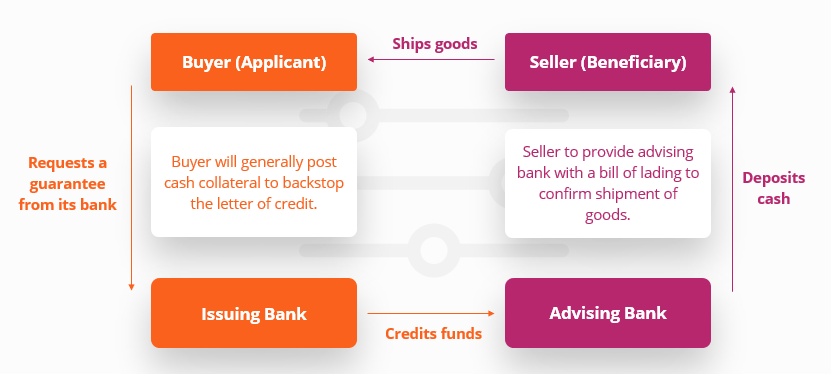
In this example transaction, the buyer is also called the Applicant. The Applicant’s financial institution is called the Issuing Bank since it will be issuing the trade instrument on behalf of its client (the applicant). The seller, in this case, is the Beneficiary (meaning they will benefit from the proceeds of the guarantee when it is called). Given that the seller is unlikely an expert in Trade Finance instruments (like LCs), its own bank, in this case, the Advising Bank will serve as an intermediary.
Assume the terms of the transaction are that payment shall be made upon shipment of physical goods. The seller will present its bank (the Advising Bank) with a bill of lading once the shipment has been confirmed. The Advising Bank will then contact the Issuing Bank to call (or redeem) the financial LC; they, in turn, will credit funds to the Advising Bank by way of some international payment network (such as SWIFT), who in turn will deposit cash into its client (the seller’s) account.
Since the Issuing Bank is required to actually remit payment when the LC is called, they need to have something highly liquid available. As a result, the applicant will generally either post cash collateral to backstop the LC, or management may be able to “carve out” a portion of its operating line of credit instead.
How a Standby Letter of Credit Works
Unlike a Financial LC, Standby LCs are issued to provide comfort to the beneficiary that payment will be forthcoming if some terms of a contract between the beneficiary and the applicant are not met.
A common use case for a Standby LC is in commercial real estate. A prospective tenant, call them Party A (the Applicant), is looking to sign a 5-year lease with Party B (the landlord and beneficiary) for a 100,000-square-foot warehouse facility.
Assume that the facility will require some modest customization. The landlord wants to know that, should they spend the money to do these renovations, Party A won’t default on its rent and leave them with a large facility that’s already been renovated to suit a specific tenant’s needs.
Party B might ask Party A for a Standby Letter of Credit in the amount of 12, 18, or perhaps even 24 months’ rent to protect its financial interest in the property. Should party A default on its rent payments, Party B would go to its own bank (the Advising Bank) and declare that the contract terms were breached. The Advising bank would notify the Issuing Bank, which would immediately remit payment on behalf of the Applicant (its client).
Like a Financial Letter of Credit, the Issuing Bank needs funds available immediately if the LC gets called. In this case, Standby LCs are similar in that they too often require some kind of highly liquid collateral, such as cash or a “carve out” from the borrower’s operating line of credit.
Financial Due Diligence for Letters of Credit
Credit analysts looking to assess the creditworthiness of an LC applicant will approach their due diligence using many of the same criteria and risk models that they would for a borrower seeking any other type of Commercial Lending. Having said that, there are two fairly unique factors:
- There’s a particular emphasis on collateral – even more so than other forms of senior-secured commercial lending. It is because the Issuing Bank needs funds immediately when an LC is redeemed.
- While the credit team will analyze a borrower’s financial statements approximately the same way as any other borrower, what’s unique about underwriting LCs is the execution. Most banks will have a Trade Finance team that is able to speak the same technical language as their counterparts at other firms; this Trade Team (or individual Trade/LC Specialist) will prepare the actual LC wording based on instructions provided by the beneficiary or its representatives. This is to say that a Loan Officer or Credit Analyst at a bank is not usually required to actually prepare or ship the physical LC.
Additional Resources
Thank you for reading CFI’s guide to Letter of Credit. To keep advancing your career, the additional CFI resources below will be useful:
Letter of Credit — Frequently Asked Questions & Answers

Here are some of the most commonly asked questions and answers on letters of credit:
1. What is a Letter of Credit?
A letter of credit is a legal written document issued by the importer/buyer’s bank in the favor of the exporter/seller to assure that the seller would be paid on-time by the buyer for their delivered goods & services. In the event of buyer defaults in fulfilling the terms & conditions of the contract or paying a certain amount in an ongoing trade transaction, the issuing bank will make the payment to the exporter. To put it in simple words, it serves as a commitment of guaranteed payment from the buyer to the seller.
2. Types of Letters Of Credit
1. Standby Letter of Credit (SBLC)
2. Credit on Sight LC
3. Time credit LC
4. Revocable and Irrevocable LC
5. Transferable and non-transferable LC
6. Usance Letter of Credit
7. Confirmed and Unconfirmed LC
8. Back to Back LC
9. Red Clause LC
10. Green Clause LC
11. Commercial Letter of Credit
12. Export/Import LC
13. Revolving Bank Credit Letter
14. Traveler’s Letter of Credit
15. Time Credit/Acceptance Credit
3. Is the LC and Bank Guarantee the same?
A Letter of credit is a legal guarantee from a bank or financial institution regarding on-time payment to the exporter in the event of the buyer’s failure to perform terms & conditions or pay a certain amount for delivered goods & services.
A bank guarantee is a commercial instrument where the bank only pays the amount if the buyer does not fulfill the contractual obligations mentioned in the contract. To know more check out our detailed blog on «What is the difference between bank guarantee and letter of credit?»
4. How does a Letter of Credit work?
1. The applicant or buyer/importer applies to the issuing bank to issue an documentary credit (LC) in favor of the exporter/seller/supplier.
2. The advisory bank (exporter’s bank) receives the letter of credit issued by the issuing bank and further forwards it to the seller after checking the authenticity of the letter of credit.
3. The seller ships the goods as per the details mentioned in the contract and receives a bill of lading as evidence of shipped goods.
4. The seller now presents the bill of lading to the nominated or negotiating bank. After checking whether the goods were delivered as per the requirements, the bank pays the seller.
5. Now the negotiating bank forwards the shipping documents to the issuing bank to release the payment.
6. The issuing bank sends the shipping documents to the buyer and verifies the information for seeking approval.
7. The buyer makes the payment to the issuing bank and the bank further sends the payment to the negotiating bank.
5. Parties Involved In Letter Of Credit
1. Applicant/Buyer/Importer — Who purchases the goods or services and applies for documentary credit (LC).
2. Issuing Bank — Who issues documentary credit.
3. Beneficiary/Seller/Exporter — It is the person in the favor of whom a letter of credit is issued.
4. Advising Bank — It is also known as an exporter’s bank
5. Nominated Bank — An International bank in the exporter’s country to receive the documents.
6. Confirming Bank — The bank which provides an additional guarantee to the undertaking of the issuing bank.
7. Reimbursing Bank — It is the bank where the paying account is set up by the issuing bank.
8. Second Beneficiary — Who represents the original beneficiary in their absence.
6. What are the benefits of a Letter of Credit?
There are many benefits of availing letter of credit services some of them are here as follows
1. Serves as a credit certificate for the buyer
2. On-time payment to the seller.
3. A safe platform to expand overseas business
4. It can be customized as per the parties’ needs.
5. Shifts risk from the buyer to the issuing bank
6. Seller receives money on fulfilling terms
7. Involves a legal guarantor, thus the payment is secured.
7. Which types of risks are there in letters of credit?
1. Delayed payment or no payment
2. Non-delivery of ordered goods and services
3. Receipt of low-quality goods
4. Exchange rate of goods
5. Risks of change in foreign exchange rates
6. Fraud altering due to the flexible Bank Credit Letters
8. What are the bank’s charges for letters of credit?
The bank’s charges or interest rates for letters of credit can vary depending on the type, size, volume, or nature of the business as well as the buyer’s relationship with the bank, financial stability or types of goods, etc.
9. How Long Does It Take To Get A Letter of Credit?
The period to get a bank credit letter depends on the issuing bank that is offering the loan. Generally, the process takes approx 10-15 working days or it can extend to some more days in getting approval from the bank.
10. What documents are required to open a letter of credit?
1. Bill of Exchange
2. Bill of lading
3. Air waybill/Road/Rail transport documents etc.
4. Health and Insurance certificates
5. Certificate of origin
6. Commercial invoice
7. Packing list or inspection certificate
8. Importer’s financial documents
9. Certificate of inception etc.
11. What are the features of letters of credit?
1. Issued against collateral that may include importer’s fixed deposit and bank deposits etc as security.
2. Bank charges certain fees depending on the type of bank credit letter(LC)
3. Rules & regulations are issued by the International Chambers of Commerce (ICC).
4. The details of letters of credit must include the name of supplier, date, amount, product name and quantity, etc.
5. Banks can deny the payment if there are any mistakes in the details of LCs
12. Is a letter of credit a loan?
The loan is a lump sum amount that needs to be repaid in a pre-decided period while a documentary credit is a credit or loan limit issued by a bank to the buyer with an option of withdrawing small amounts from the total issued limit. Moreover, LCs involve a guarantor ie. Bank.
13. What is a letter of credit with an example?
Let’s assume, a Company XYZ purchases the goods worth $100,000 from an overseas supplier called Company ABC. On the demand of ABC, the Company XYZ approaches its Bank for issuing bank credit letters in the favor of ABC. After shipping goods, the Company ABC asks for the payment of $100,000 from XYZ’s bank by presenting shipping documents. The XYZ’s Bank pays company ABC, it turns out to Company XYZ to reimburse the issuing bank.
14. Who issues a letter of credit?
A letter of credit also known as documentary credit is a legal undertaking issued by an importer’s bank or a private institution to ensure timely and full payment to the exporter. If the importer defaults, it is reimbursed by the issuing bank.
15. What are LC terms of payment?
A documentary credit is a payment term, also known as a payment guarantee letter as it backs an international transaction with the involvement of a legal authority like Banks or Private financial institutions for both importers and exporters.
16. Who pays for a letter of credit?
Generally, both the parties to the contract i.e. Importers and Exporters pay for the charges of letter of credit. The charges include a pre-described percentage of the invoice value underwritten which can be from 0.1% to 2.0% of the commercial invoice value per month.
17. What is the cost of a letter of credit?
The lenders charge generally 2 percent along with the documentation fees which need to be paid by the borrower at closing or 2.5% for amounts below $50,000 in case of Standby LCs.
18.What is the LC limit?
The working capital limit for a bank credit letter agreement is decided based on the yearly consumption of raw material to be purchased. Bank verifies the sources of funds with the customer for the retirement of LC opened for buying capital goods.
19. What is LC 90 Days?
Issuance of a letter of credit can be LC 90 days, LC 60 days, or more rarely, LC 30 days. It simply stands for the funds promised in the bank credit letter (LC) are due in 90, 60, or 30 days.
20. What is LC 30 days?
LC 30 days means that the funds of bank credit letter (LC) are payable 30 days after BL. If the BL date is 1 June, the payment will be done on 1 July.
21. How can you tell a fake letter of credit?
You need to make sure that the LC agreement consists of the Date of Issue. It also includes flexibility to make shipment before the latest date of shipment, presentation of documents before the expiry date of documentary credit(LC), and verification of expiry location of bank credit letter.
22. What is LC opening?
A letter of credit is opened by the buyer’s bank at the request of the buyer.
23. Is a Letter of Credit Safe?
A letter of credit is a safe, reliable, and trustworthy trade finance service for both sellers and buyers. In case of the buyer defaults, the bank pays the seller. On the other hand, the buyer is assured of releasing payment to the seller only after fulfilling terms & conditions.
24. How do I get a bank letter of credit?
You need to contact your bank for the issuance of an LC. Or you can also approach private financial institutions offering these types of services.
25. Why do I need a letter of credit?
Letters of credit are essential payment guarantee letters for international transactions since they ensure exporters that the payment will be received on-time. It reduces the associated risk of non-payment for the delivered goods.
26. What is the difference between TT and LC?
LC means documentary credit, an instruction from the applicant to the issuing bank for paying the seller a sum of money after certain conditions are fulfilled. TT stands for Telegraphic Transfer, Telex Transfer or Wire Transfer, the transfer of funds from one bank account to another by electronic modes.
27. What is the LC expiry date?
The LC expiry date refers to the last date of submitting the exported documents with the bank for negotiation.
28. What is LC discounting?
It is a short-term credit facility provided by the bank to the seller after confirming the original documents.
29. How do I cancel my LC?
According to the rules of the documentary credit, it should be issued in an irrevocable form so that it cannot be canceled without the consent of the beneficiary.
30. Can a letter of credit be used as collateral?
Yes. A letter of credit is used as collateral by the seller on a loan or purchase.